
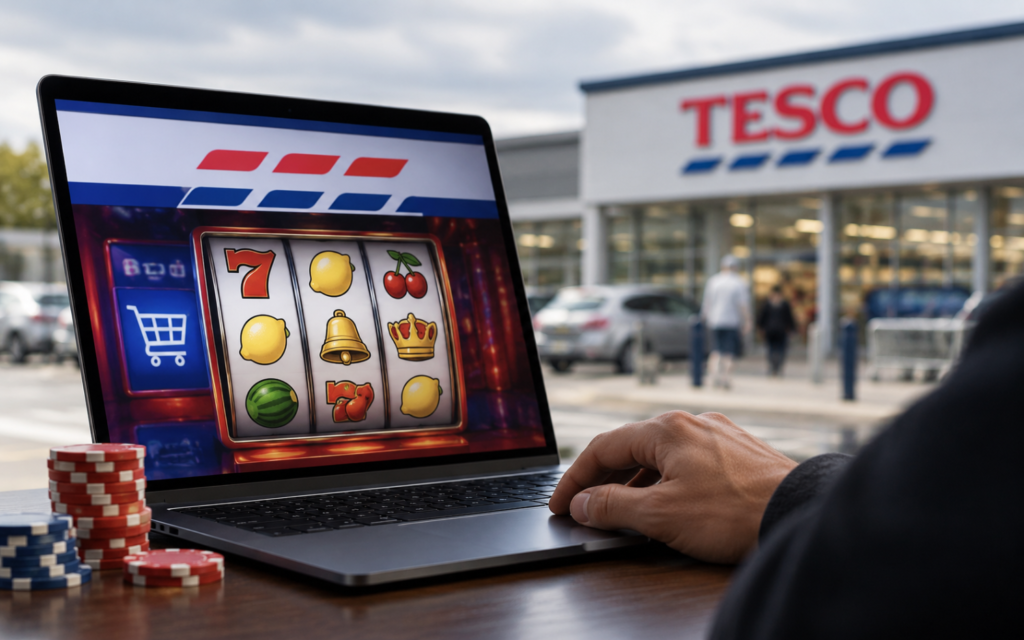
Tesco’s name and visual identity have been appropriated by an unauthorised online casino targeting British consumers, adding to concerns over increasingly aggressive attempts by illegal gambling operators to exploit trusted UK brands.
The website, branded as “Tesco Slots”, has been promoted through advertisements on Meta-owned platforms and uses the supermarket group’s familiar red-and-blue branding to create the impression of an official Tesco gambling product. SBC News reported that the site remained accessible from the UK and presented itself as a casino connected to Tesco’s wider services.
The operation has no known connection to Tesco. The Guardian separately reported that Tesco had contacted City of London Police after discovering that its brand had been used in deceptive casino advertisements appearing on Facebook and Instagram. Meta removed a number of the advertisements following media enquiries.
The fake casino goes beyond simply copying Tesco’s branding. Its website refers to Tesco Bank, Tesco Mobile and supposed Tesco-linked payment methods while presenting gambling rewards in a way designed to resemble the supermarket’s Clubcard loyalty programme.
It also advertises a welcome package worth £1,500 alongside 250 free spins and attempts to strengthen its appearance of legitimacy by referencing UK gambling rules, including the prohibition on credit-card gambling.
Licensing claims raise further questions
The site claims to operate under a Curaçao Gambling Authority licence. However, SBC reported that it could not identify a registered “Tesco Slots” operator in Curaçao’s licensing records.
Most links on the website reportedly redirect users to a domain containing “101nightwin”, with an identification parameter that an SEO specialist consulted by SBC said appeared consistent with an affiliate tracking link. The company responsible for operating the Tesco-branded website has not been publicly identified.
SBC also identified a possible connection worth examining between the redirect domain and NightWin, although it stressed that no direct relationship had been established.
NightWin has been associated with Flybergom B.V., a Curaçao-registered operator holding licence OGL/2024/2241/1178. Official Curaçao records show that the licence was issued on 26 September 2025 with a 26 March 2026 date attached to it. A subsequent April 2026 regulatory register listed Flybergom’s status as “Assessment in progress”.
That does not establish that Flybergom or NightWin operates the Tesco-branded site, and SBC said it had contacted the Curaçao Gambling Authority for clarification.
Tesco case forms part of wider illegal advertising problem
The incident follows a series of cases in which gambling websites have attempted to borrow the credibility of recognised organisations, celebrities and public bodies.
The Guardian reported that unauthorised casino advertising has also misused brands or identities connected with Barclays and prominent sports figures including Lewis Hamilton, Tyson Fury, Erling Haaland, Jude Bellingham and Bruno Fernandes.
Other recent incidents have involved compromised or poorly maintained websites associated with UK public organisations. SBC highlighted previous cases involving an NHS-linked website, Scottish Borders Council infrastructure and Old Catton Parish Council, where legitimate web properties were exploited to promote gambling services.
The UK government has responded to the broader threat by establishing an Illegal Gambling Taskforce. Its stated priorities include disrupting payments to illegal operators, tackling their online advertising and improving coordination between regulators, law enforcement, technology platforms, payment providers and the gambling industry.
The Advertising Standards Authority is participating in that effort and chairs a taskforce subgroup focused on advertising. The regulator said in May that illegal gambling promotions present particular risks because the operators behind them sit outside Britain’s licensed system. It has been sharing intelligence with the Gambling Commission and working with online platforms to identify and remove illegal gambling advertisements.
The Tesco case demonstrates how operators targeting the UK black market are increasingly combining familiar brands, social-media advertising and misleading regulatory claims to make unlicensed gambling websites appear legitimate.