
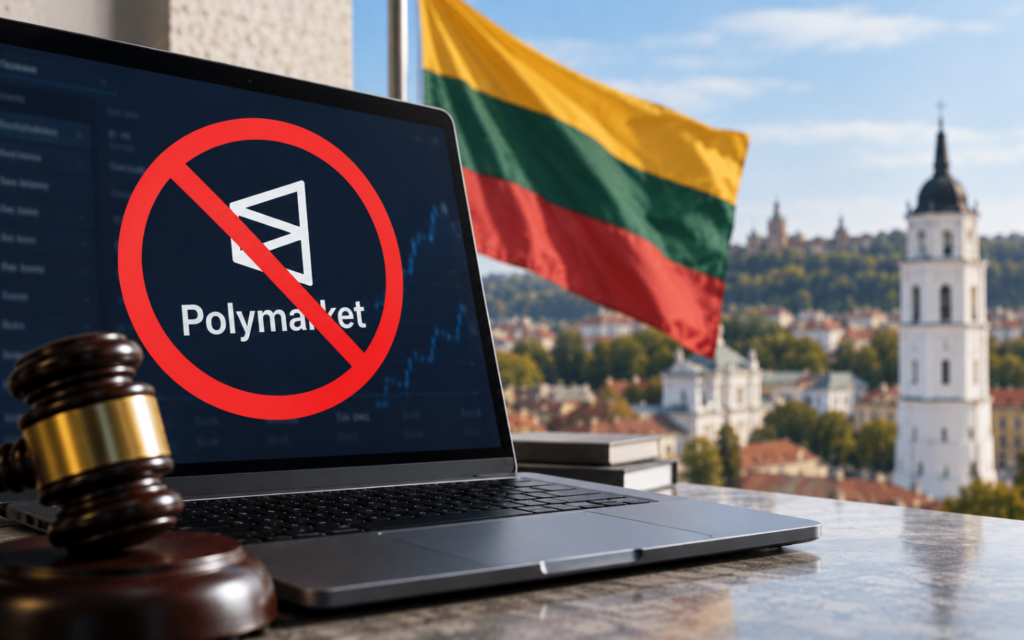
Lithuania’s Gambling Supervisory Authority has ordered internet and payment providers to block Polymarket after determining that the prediction-market platform was offering gambling services without the licences required in the country.
The Lošimų priežiūros tarnyba (LPT), which operates under Lithuania’s Ministry of Finance, said its investigation found characteristics of conventional betting despite Polymarket describing its service as a prediction market. The platform has become the first prediction-market operator added to Lithuania’s list of illegal gambling websites.
During the investigation, officials were able to open an account, deposit funds and make predictions on the outcome of real-world events at predetermined odds. Depending on the result, users could either receive a payout or lose the amount they had committed.
The regulator concluded that this activity constituted betting and was being provided without a Lithuanian gambling licence or permit.
After securing approval from the Regional Administrative Court, the LPT instructed communications providers to restrict access to Polymarket. Payment service providers were also ordered to stop transactions involving Adventure One QSS, Inc., the company identified by the regulator as operating the illegal gambling service.
Polymarket is the first platform of its type targeted under Lithuania’s blocking regime, but it joins a much larger group of offshore gambling websites restricted by the authorities. The LPT said 2,204 illegal remote gambling sites had been blocked in Lithuania by the time of its Polymarket announcement.
The Lithuanian action follows increased regulatory scrutiny of prediction markets elsewhere. France’s National Gambling Authority ordered internet providers to block Polymarket in July 2026, stating that the platform promoted gambling services that were not authorised under French law. The French regulator had previously raised concerns over Polymarket’s activities and said earlier geoblocking measures could be circumvented.
Polymarket has also faced restrictions in several other European jurisdictions, including Spain, Germany, Italy and the Netherlands, while South Korean authorities moved against the platform in August.
Lithuania’s decision reinforces the regulatory challenge facing prediction-market operators in jurisdictions where authorities consider trading on uncertain real-world outcomes to fall within existing gambling legislation rather than a separate financial or information-market category.