
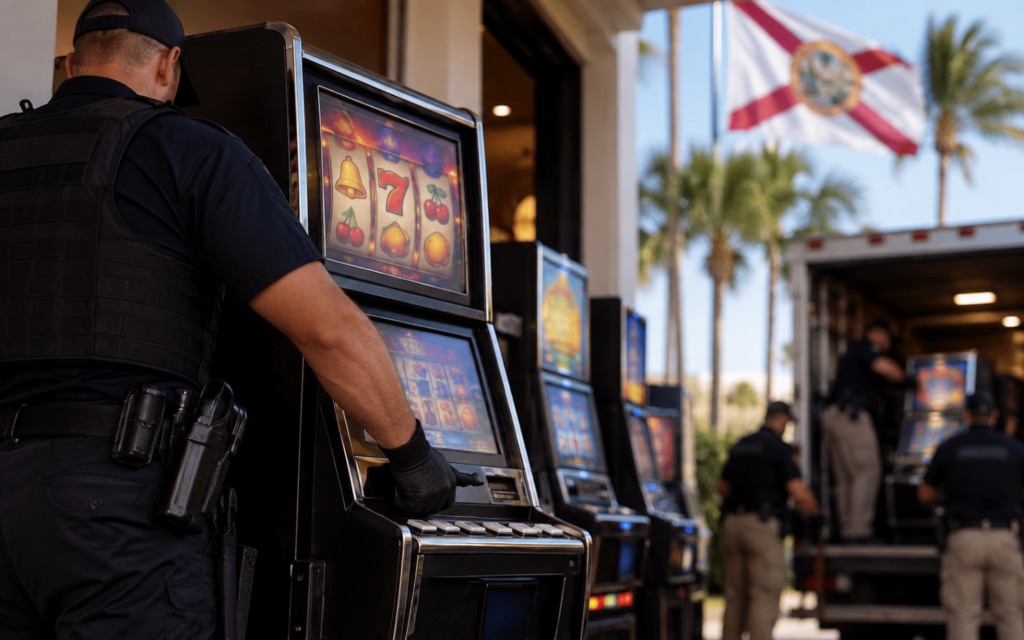
Florida is expanding its efforts to shut down illegal gambling businesses, with regulators reporting thousands of slot machine seizures and local authorities introducing new restrictions. However, the Florida Gaming Control Commission (FGCC) has warned that existing criminal penalties allow some operators to resume activities after enforcement actions.
On 22 September, Manatee County commissioners unanimously approved Ordinance 26-36, introducing additional restrictions on unauthorized simulated gambling devices in unincorporated areas. The measure provides civil enforcement powers, including cease-and-desist orders and citations, alongside misdemeanor penalties.
The county also approved an agreement with the Manatee County Sheriff’s Office to coordinate enforcement against illegal gambling establishments.
The ordinance follows repeated raids across Southwest Florida, where authorities have identified businesses reopening or relocating after their equipment was confiscated. The FGCC is seeking stronger statewide criminal penalties ahead of Florida’s 2027 legislative session.
Thousands of Machines Seized Across Florida
Florida’s gambling regulator confiscated 6,725 illegal slot machines and $14.47 million in 2025, compared with 1,287 machines and $7.11 million in 2024.
According to figures provided to Gambling Insider, the FGCC has seized another 3,959 machines and $3,147,069 in illegal gambling proceeds during 2026.
The commission also reported in July that authorities had closed 184 illegal gambling arcades and made 177 arrests over the preceding 12 months.
Southwest Florida has been a major focus of enforcement operations. In June, investigators confiscated 479 machines and $294,150 during a multi-day operation across Lee and Collier counties, resulting in 11 arrests.
A separate May operation recovered 265 machines in Manatee County, while 34 additional machines were seized in Bradenton in July.
In Sarasota County, authorities confiscated 69 machines in May and another 76 in August.
Elsewhere, a February investigation targeting 39 locations across multiple counties resulted in 525 machines being seized. Authorities also confiscated 231 machines in Lake County in January and 163 machines from two St. Petersburg arcades in September.
Despite these operations, regulators acknowledge that confiscating equipment and closing premises does not necessarily prevent illegal gambling businesses from returning.
Existing Criminal Penalties Remain a Challenge
Florida’s current legislation allows authorities to prosecute individuals involved in unauthorized slot machine operations, but the penalties increase gradually for repeat offenders.
Under Section 849.23 of Florida law, a first conviction for violating the state’s slot machine provisions constitutes a second-degree misdemeanor. A second conviction is classified as a first-degree misdemeanor, while a subsequent violation following two previous convictions becomes a third-degree felony.
FGCC Chair Julie Brown has argued that misdemeanor penalties provide insufficient deterrence because some operators can absorb fines and equipment losses before establishing businesses elsewhere.
The commission has confirmed that certain operators continue relocating or reopening following enforcement actions, making stronger criminal penalties a priority for the next legislative session.
Florida Attorney General James Uthmeier has also supported tougher action against unauthorized gambling operations.
Legislative Proposals Fail to Secure Approval
Florida lawmakers considered several gambling enforcement bills during the 2026 legislative session, but none secured final approval.
Senator Jonathan Martin’s SB 1580 proposed increased penalties for illegal slot machine and gambling-house offenses. It also addressed slot machine trafficking, misleading claims about machine legality, procedures for disposing of confiscated equipment and a temporary surrender programme.
The Senate approved the legislation by 34 votes to zero. The House subsequently passed an amended version by 82 votes to 31, but the chambers failed to agree on a final text before adjournment.
Representative Dana Trabulsy’s HB 189 also sought stronger illegal gambling enforcement alongside changes addressing internet gambling, fantasy sports, pari-mutuel wagering and other gaming regulations. The proposal progressed through several House committees before being set aside in favour of SB 1580.
Senator Jennifer Bradley’s SB 204 combined provisions affecting certain veterans organisations with escalating criminal penalties for illegal slot machine operations. It advanced through two committees before failing to progress through the Rules Committee.
Two further proposals, HB 591 and SB 1164, did not advance beyond their initial committees.
The FGCC intends to revisit its legislative priorities in 2027, including changes to the handling and disposal of confiscated slot machines. The regulator has warned that machines retained as evidence for several years generate storage costs and logistical difficulties for law enforcement agencies.
Additional Enforcement Resources and Local Restrictions
Although lawmakers did not approve the proposed criminal law changes, Florida authorised two additional FGCC enforcement units in May 2026, including a Sarasota County-based unit dedicated to Southwest Florida.
The commission has also expanded cooperation with law enforcement agencies, with 48 agencies now participating in efforts to combat illegal gambling across the state.
Federal authorities have supported several investigations. Homeland Security Investigations participated in the May Manatee County operation and led a separate December 2025 investigation alongside the Internal Revenue Service, FGCC and Clay County Sheriff’s Office.
Manatee County’s newly adopted ordinance adds local enforcement powers against unauthorized simulated gambling devices. However, its criminal provisions remain misdemeanors and do not introduce the felony penalties sought by the state regulator.
The Manatee County Sheriff’s Office has indicated that the ordinance is intended to make it more difficult for illegal gambling establishments to reopen after enforcement actions.
While Florida continues to report substantial equipment seizures, cash confiscations and arrests, comprehensive public data on repeat offenders, reopened establishments and the total number of illegal machines in circulation remains limited.
The FGCC maintains that its enforcement operations have strengthened the state’s response to unauthorized gambling but acknowledges that the illegal market has not been eliminated.