
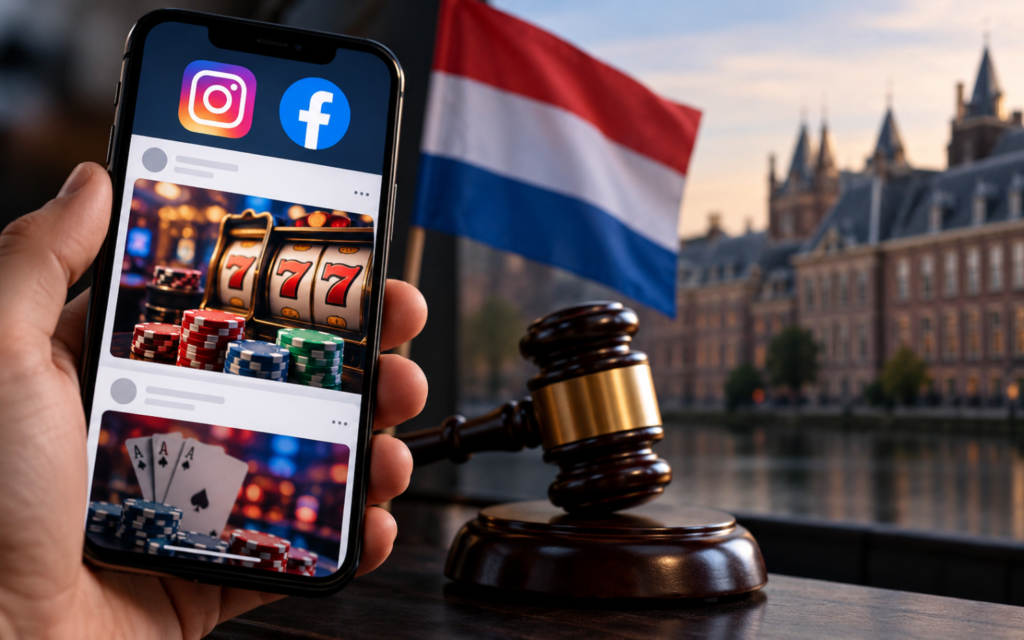
Pressure is mounting on the Netherlands Gambling Authority, Kansspelautoriteit (KSA), to take stronger action against Meta over the continued spread of illegal gambling advertising on Facebook and Instagram.
Dutch gambling lawyer Justin Franssen, a partner at Franssen Tolboom Attorneys at Law, criticised the regulator during an SBC Summit panel, arguing that existing Dutch gambling legislation already provides tools that could potentially be used against platforms that facilitate prohibited gambling promotion.
Franssen questioned why enforcement against Meta and other large platforms has increasingly been left to licensed operators and industry organisations rather than being driven directly by the regulator. His comments came as Dutch gambling trade association VNLOK continues legal proceedings against Meta over advertisements promoting operators without a Dutch licence.
VNLOK turns to courts after Meta talks fail
VNLOK announced in June that it would take Meta to court and file a complaint with the European Commission after concluding that attempts to secure structural changes through dialogue had failed.
The association wants a Dutch court to determine whether Meta has breached obligations under the EU Digital Services Act and to require the company to strengthen systems designed to detect and prevent illegal gambling advertising. VNLOK is also seeking the possibility of financial penalties if Meta fails to comply with any resulting court order.
The summons was filed with the Amsterdam District Court. No hearing date had been announced by the beginning of October, while a dispute over jurisdiction remains possible because Meta’s European operations are based in Ireland.
VNLOK chairman Björn Fuchs said the organisation resorted to litigation after communications with Meta repeatedly resulted in automated responses rather than substantive cooperation.
The dispute has become increasingly important as research commissioned by VNLOK continues to show a high proportion of unlicensed gambling advertising across Meta’s platforms.
Its August study found that 96.5% of the 65,000 highest-reach gambling advertisements examined in May promoted unlicensed operators. The proportion was 93.7% in June.
Meta removed 11% of the illegal adverts identified in May and 15% in June. However, many campaigns were short-lived: 76% of the advertisements tracked in May remained active for less than one day, making reactive removal less effective once significant exposure had already occurred.
The research also identified increasingly sophisticated techniques, including cloaking, redirects through Telegram and the unauthorised use of recognised Dutch gambling brands. Some advertisers used pages unrelated to gambling to disguise campaigns before sending consumers to offshore operators.
KSA has reported thousands of Meta adverts
The KSA has acknowledged the scale of the problem. In April alone, the regulator submitted more than 4,600 reports concerning illegal advertisements on Facebook and Instagram.
The authority has said offshore operators regularly use the identities of well-known Dutch athletes and established brands to make promotions appear legitimate. It has also made combating illegal gambling and the infrastructure supporting offshore operators one of its regulatory priorities for 2026.
KSA officials have nevertheless emphasised cooperation with technology companies, payment providers, hosting companies and other intermediaries as part of a broader strategy against offshore gambling.
The regulator acknowledged earlier this year that cooperation with major technology platforms had not yet produced sufficient results. It has been holding discussions with Meta, Google and other companies while also coordinating with gambling regulators elsewhere in Europe.
That strategy is at the centre of the latest criticism. Franssen argued that Dutch legislation was expanded from simply prohibiting advertising for illegal gambling to also covering the facilitation of prohibited gambling activity, raising questions over whether platforms carrying those advertisements could face direct regulatory intervention.
VNLOK has similarly called on the KSA to take stronger action against platforms, marketing companies and affiliates that help direct Dutch consumers towards unlicensed gambling services.
European scrutiny of Meta grows
The Dutch dispute is also developing against broader EU scrutiny of Meta under the Digital Services Act.
The European Commission previously issued preliminary findings that Meta’s mechanisms for users to report illegal content on Facebook and Instagram may fail to meet DSA requirements for accessibility and effectiveness. Separate proceedings have examined the company’s advertising systems and other platform risks.
VNLOK believes that European intervention will ultimately be necessary because illegal gambling advertisements are not confined to the Netherlands. The organisation is exchanging information with gambling industry bodies in countries including Denmark, Sweden, Germany, France, Spain and the UK.
For the Dutch licensed market, however, the immediate dispute remains focused on responsibility: whether social platforms should prevent illegal gambling advertising before campaigns reach consumers, and whether the KSA should move beyond reporting offending advertisements and begin using stronger enforcement measures against the companies facilitating their distribution.