
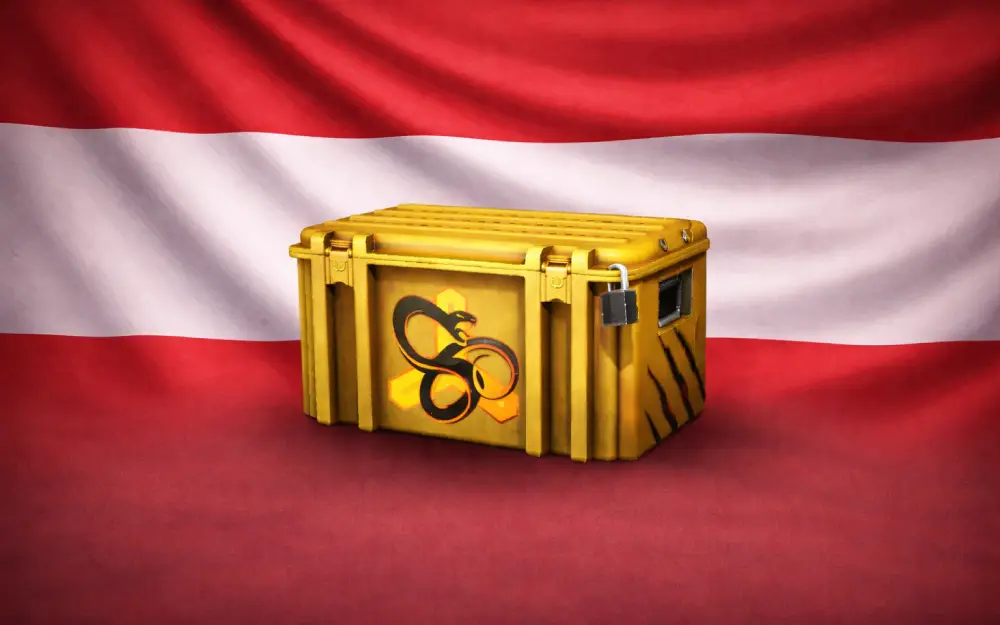
Austria’s highest court has delivered one of Europe’s clearest legal statements yet on loot boxes, ruling that paid randomised rewards in video games do not constitute gambling under national law.
The decision from Austria’s Supreme Court closes a case that has lingered for years, brought by a player seeking reimbursement for thousands of euros spent on in-game points used to purchase loot boxes. The claimant argued that the system relied on chance, required real-money payments, and therefore amounted to illegal gambling operated without a licence.
The court disagreed – and, crucially, did so by looking beyond the randomness of individual purchases.
Skill outweighs chance, court says
Rather than isolating loot boxes as a standalone mechanic, the judges assessed the structure of the game as a whole. Their conclusion was that player skill, strategy, and in-game decision-making dominate the experience, with random elements playing a secondary role.
Because chance does not determine success in a decisive way, the game failed to meet Austria’s legal definition of gambling. The ruling reinforces the idea that courts must evaluate game mechanics in their broader functional context, not through narrow comparisons with casino-style products.
In effect, the presence of randomness alone is not enough to trigger gambling law.
No cash-out, no gambling
The court placed particular emphasis on what happens after a loot box is opened. While the digital items obtained may vary in rarity or usefulness, they remain locked inside the game ecosystem.
Players cannot legally sell, trade, or convert these items into real money outside the platform. That lack of real-world exchangeability was treated as a decisive legal boundary. Traditional gambling products, the court noted, allow players to transform winnings into cash or assets with economic value beyond the game itself.
Without that external value, loot boxes fall on the entertainment side of the legal divide.
A signal beyond Austria
Although the ruling applies only under Austrian law, its reasoning is likely to resonate across Europe, where regulators and courts continue to wrestle with how to classify monetised game mechanics.
Some countries have pushed for tighter controls or outright bans on loot boxes, particularly where minors are involved. Others have struggled to fit them neatly into existing gambling frameworks. Austria’s approach offers a more structural test: does chance dominate outcomes, and can rewards be monetised outside the game?
If the answer to both is no, gambling law may not apply.
What it means for the industry
For game publishers, the decision provides a measure of legal clarity in a fragmented European landscape. It suggests that well-designed games, where skill remains central and virtual items are non-transferable, are less likely to fall foul of gambling statutes.
For regulators, the ruling underscores the limits of applying traditional gambling concepts to digital entertainment. As games continue to blend progression systems, randomness, and monetisation, courts may increasingly focus on economic reality rather than surface-level similarities to betting.
Austria’s message is a narrow one, but a clear one: not every random reward is a wager, and not every paid mechanic belongs under gambling law.