
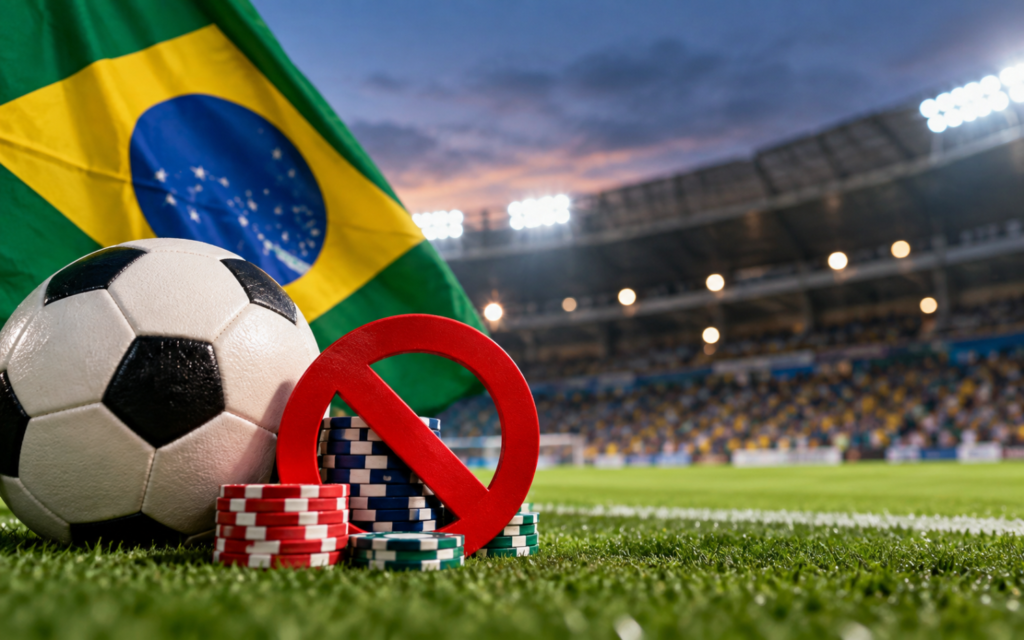
Brazil’s licensed betting industry has taken its opposition to the country’s new online gambling ban into football stadiums, using pitch-side advertising space to warn that prohibition could accelerate the growth of unregulated operators.
Companies linked to the National Association of Games and Lotteries (ANJL) and the Brazilian Institute of Responsible Gaming (IBJR) replaced conventional advertising on perimeter boards with campaign messages during top-flight matches involving São Paulo and Santos on Friday and Atlético-MG and Bragantino on Saturday.
The coordinated action followed President Luiz Inácio Lula da Silva’s Provisional Measure 1,394, signed on 25 September. The measure prohibits the operation, supply, intermediation and advertising of fixed-odds betting across Brazil and applies to both sports betting and online gaming. Licensed operators were also prevented from accepting new deposits, ahead of the shutdown of regulated betting platforms from 6 October.
ANJL and IBJR argue that eliminating the regulated market will not eliminate consumer demand for gambling. Instead, the associations believe bettors will increasingly move towards offshore and illegal websites that do not provide the player protections, responsible-gambling controls or regulatory oversight required from licensed companies.
The organisations have also raised concerns about the financial consequences for Brazilian sport. Betting sponsorships had become an important source of income for leading football clubs, while operators had built commercial plans around licences and rules introduced by the Brazilian government. Reuters reported that betting sponsorships generated approximately BRL1 billion ($192 million) for clubs in 2025, representing roughly 10% of recurring revenue.
Industry monitoring cited by ANJL highlights the scale of the illegal-market threat. Its Legitbet platform identified 6,401 new unauthorised betting websites between 22 and 28 September, together with 811 links directing consumers towards those sites. Before the prohibition, illegal operators were already estimated to account for 41% of betting volume in Brazil.
ANJL and IBJR have taken their opposition beyond the advertising campaign. The two associations asked Brazil’s Supreme Federal Court to suspend the provisional measure, arguing that companies invested heavily after receiving government authorisation under the regulated framework. The case is being handled by Supreme Court justice Luiz Fux.
Despite opposing prohibition, the organisations have acknowledged concerns surrounding gambling-related harm and household debt. They have said the licensed sector is prepared to discuss stronger safeguards, including deposit and playing-time limits, tighter advertising standards, additional mental-health support and more aggressive measures against illegal operators.
Their position is that these protections can be enforced only within a regulated system, while operators outside Brazil’s legal framework remain beyond the reach of the same consumer-protection requirements.