
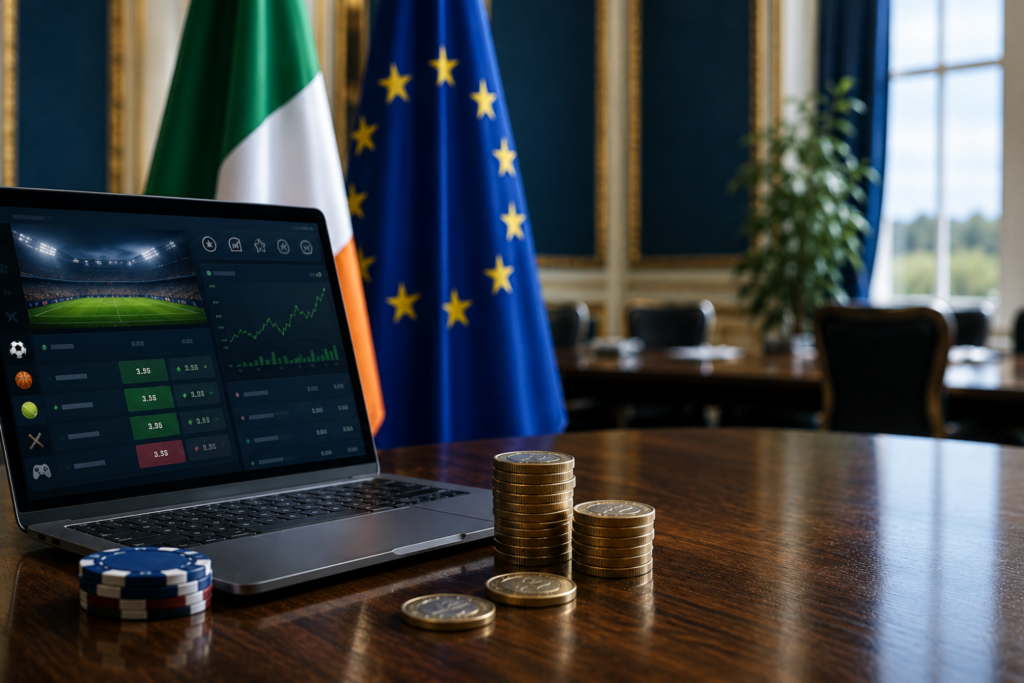
Ireland’s presidency of the Council of the European Union is putting Dublin at the centre of negotiations over the bloc’s next long-term budget, with a proposed EU-wide levy on online gambling among the possible new revenue sources under discussion.
Ireland has held the rotating Council presidency since 1 July 2026 and will remain in the role until the end of December. During that period, the government is responsible for chairing Council meetings and helping the 27 member states find common ground on major legislative and policy files, including the EU’s Multiannual Financial Framework for 2028-2034.
The European Commission proposed a long-term budget worth close to €2 trillion for the next seven-year cycle, as the EU looks to increase spending on areas including defence, competitiveness, digitalisation, migration and climate policy while continuing to finance existing programmes. Parliament has pushed for an even larger package, backing a position equivalent to around €1.94 trillion in real terms and arguing that repayment of pandemic-era borrowing should not reduce funding for other priorities.
A central question in the negotiations is how the EU will finance that spending without relying as heavily on direct contributions from national governments.
Gambling joins search for new EU revenue
The Commission’s formal funding plan already contains a package of five proposed new “own resources”, including measures linked to tobacco excise duties, non-collected electronic waste and contributions from larger companies operating in the single market.
Together with related measures, the Commission estimates those proposals could generate about €58.5 billion per year in 2025 prices. Any new own resources would require unanimous approval from EU governments and, where necessary, ratification under national constitutional procedures.
Online gambling has emerged as an additional option promoted by members of the European Parliament.
Parliament included an online gambling and gaming tax among alternative revenue sources that could be considered alongside levies on digital services and crypto-related capital gains. MEPs have argued that the EU needs additional revenue streams to support the 2028-2034 budget and reduce pressure on national contributions.
European Parliament Vice-President Victor Negrescu has been one of the leading supporters of the proposal. Earlier discussions considered a levy capable of generating between €2 billion and €4 billion annually, depending on its design and tax base.
More recent Commission modelling has examined a 3% levy on the net turnover of the online gambling sector. Under that scenario, Brussels estimated average proceeds of roughly €1.9 billion per year between 2028 and 2034, equivalent to approximately €13.3 billion across the full seven-year budget period.
The figures remain estimates rather than an agreed tax proposal. The Commission has acknowledged significant practical obstacles, including the absence of a single EU definition of gambling and major differences in how member states currently tax the sector.
Industry warns against EU-wide approach
The possibility of a common levy has also drawn opposition from the gambling industry.
The European Gaming and Betting Association has argued that taxation remains deeply integrated into national gambling frameworks and warned that an additional EU-level charge could weaken regulated operators while giving unlicensed offshore competitors an advantage.
Europe’s gambling landscape remains highly fragmented despite a broad shift towards competitive licensing systems. Different countries apply their own licensing structures, product restrictions and tax rates, making a harmonised fiscal mechanism difficult to implement without major coordination between governments.
The financial stakes are significant. Industry data compiled by EGBA and H2 Gambling Capital estimated Europe’s online gambling market at €47.9 billion in gross gaming revenue in 2024, with the figure projected to rise to €66.8 billion by 2029.
Ireland faces difficult compromise
Ireland’s role is particularly notable because the country is simultaneously implementing one of Europe’s newest gambling regulatory systems while leading Council negotiations.
Dublin will not determine the outcome by itself. Any EU own-resource arrangement would ultimately require unanimous support from all 27 member states, giving individual governments considerable power to block proposals they believe interfere with domestic taxation policy.
Ireland’s presidency nevertheless gives it an important role in shaping negotiations and attempting to bridge differences between member states during the second half of 2026. Its broader presidency programme lists competitiveness and European security among its central priorities, both of which are closely tied to the debate over the size and financing of the next EU budget.
For gambling companies, the key issue is therefore no longer simply whether some lawmakers support an EU levy. The larger question is whether governments can agree that online gambling should become a source of EU-level revenue at all.
With unanimous approval required and national gambling tax systems varying sharply across Europe, an industry-wide levy remains far from certain. But its inclusion in Parliament’s budget proposals and the Commission’s work on potential revenue estimates mean the idea has progressed beyond a theoretical discussion and is now part of the wider battle over how Europe will finance its priorities from 2028.