
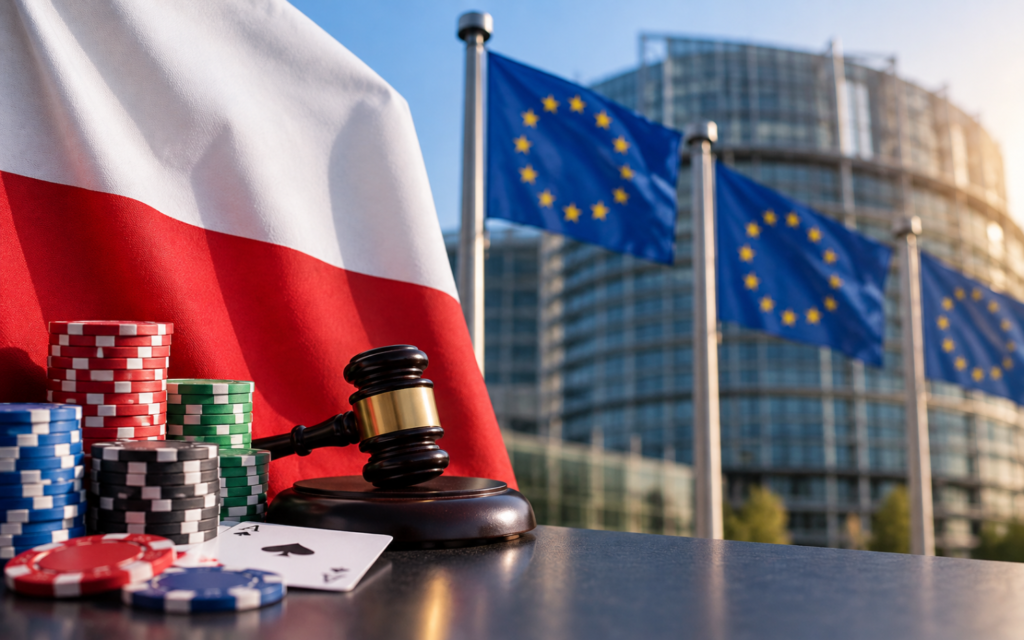
Four major Polish gambling industry associations have jointly opposed a proposed European Union gambling tax, warning that additional charges on licensed operators could strengthen illegal competition and undermine national tax revenues.
The organisations have called for any EU-wide taxation initiative to be accompanied by harmonised gambling regulations, consistent consumer protection standards and stronger measures against unlicensed operators.
The dispute centres on a proposal introduced in early 2026 by European Parliament Vice-President Victor Negrescu, who suggested a 1% levy on Europe’s licensed online gambling sector. The measure is intended to provide an additional revenue stream for the EU’s 2028–2034 Multiannual Financial Framework.
In June, Negrescu’s office confirmed that the proposal was gaining support in budget discussions in Brussels. European Commissioner for Budget, Anti-Fraud and Public Administration Piotr Serafin subsequently indicated that the Commission was examining different revenue options, including a gambling levy.
However, the proposal was not included in the European Commission’s original budget package presented in 2025. Malta and the European Gaming and Betting Association (EGBA) have already expressed opposition to the measure, with Polish industry representatives now joining the debate.
Polish Operators Warn of Higher Costs and Illegal Competition
The four Polish associations argue that introducing a common gambling tax without addressing differences between national regulatory systems would place licensed businesses at a competitive disadvantage.
Under Poland’s existing framework, licensed betting operators pay a 12% tax on turnover. According to the associations, this can account for more than half of an operator’s gross gaming revenue (GGR), before additional expenses associated with regulatory compliance and business operations.
They warn that an additional European levy could reduce the profitability of licensed operators while making unlicensed gambling websites more attractive to consumers.
The organisations also argue that migration towards illegal platforms could ultimately reduce national tax collections rather than increase public revenue. They identify weaker consumer protection and the expansion of the unregulated market as further potential consequences.
A central concern is the disparity between gambling regulations across EU member states. Licensed operators must comply with different national licensing requirements, tax structures and market access conditions, while illegal offshore platforms can target consumers across multiple jurisdictions without meeting those obligations.
The Polish representatives maintain that harmonising taxation alone would not address these competitive differences.
Instead, they are calling for common EU market access rules, enforceable consumer protection standards and stronger cross-border cooperation against illegal gambling operators.
The associations emphasise that they are not challenging the authority of European institutions or national governments to establish fiscal policies. Their objection concerns the introduction of additional financial obligations without corresponding measures to protect regulated businesses and consumers.
EU Tax Proposal Faces Member State Approval Requirements
The joint position was endorsed by the boards of the Polish Chamber of Commerce of the Entertainment and Bookmaking Industry, the Bukmacherzy Razem Association, the Play Legally Association and the Association of Employers of the Entertainment and Gaming Industry.
Their intervention adds to existing industry opposition as European institutions consider potential new revenue sources for the EU’s next long-term budget.
Neither the European Commission nor the European Parliament can introduce the proposed gambling tax independently. Its adoption would require the agreement of all EU member states.
Malta has already registered its opposition, while the Polish gambling industry’s joint statement does not itself constitute a formal position by Poland’s government.
The proposed 1% levy therefore remains under discussion, with no final agreement on its introduction. The Polish associations are urging European policymakers to consider broader regulatory harmonisation and measures against illegal gambling alongside any future taxation initiative.