
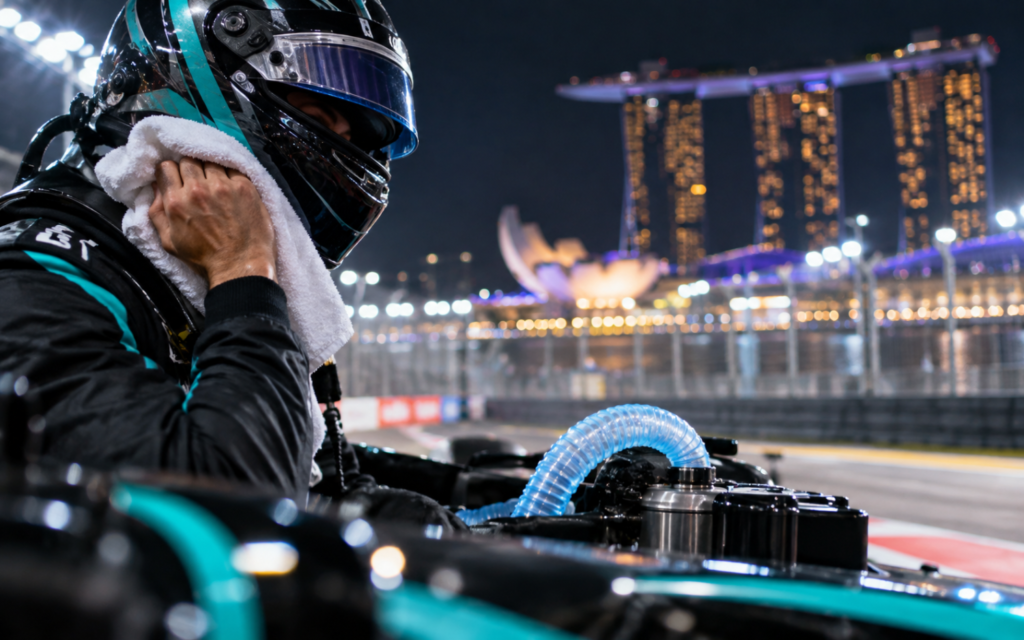
The Singapore Grand Prix has been classified as a heat-hazard race, marking the second consecutive Formula 1 weekend to receive the designation and the fourth such event of the 2026 season.
The classification is triggered when forecasts indicate temperatures could exceed 31C during the race. It allows teams to install dedicated driver-cooling systems designed to reduce heat stress inside the cockpit.
Singapore has long ranked among Formula 1’s toughest events because of its tropical climate. Daytime temperatures typically sit between 31C and 33C across the weekend, while high humidity adds to the physical strain. Even with the race held at night, conditions usually remain close to 30C.
Heat management became a major concern at the venue in 2024, when Mercedes drivers George Russell and Lewis Hamilton required treatment for heat exhaustion after the race.
Under the current regulations, drivers can use a cooling vest connected to a tank and pump installed in the car, normally around the nose section. The system circulates chilled liquid, such as glycol, through tubing incorporated into a fire-resistant top worn beneath the race suit.
Use of the equipment remains optional. Drivers who decide against it must instead carry an additional 5kg of ballast so they do not gain a weight advantage.
The technology presents several practical difficulties. Keeping the liquid cold for an entire race is challenging, particularly in Singapore, which regularly produces one of the longest grands prix on the calendar. If the fluid warms up, it can eventually approach the much higher temperatures inside the car, where cockpit conditions can exceed 40C.
Some drivers also find the cooling garments restrictive or uncomfortable inside Formula 1’s tightly packaged cockpits.
Mercedes is among the teams that has chosen not to prioritise development of the system. The team decided that the resources required to create a reliable solution would be better directed towards improving overall car performance.
The FIA has introduced cost-cap allowances to encourage further development. Teams can receive an additional $50,000 of permitted spending if they produce a system capable of maintaining effective cooling throughout a full grand prix, while another $75,000 is available for improving the comfort of the wearable element.
Mercedes deputy team principal Bradley Lord indicated that the available allowance was not considered large enough to justify the development programme needed to guarantee race-long reliability.
Singapore joins the Austrian, Italian and Bahrain Grands Prix in Malaysia among the races given heat-hazard status this season. The designation was introduced in 2025 as Formula 1 increased its focus on protecting drivers from extreme cockpit temperatures.