
How House Edge Actually Changes Under Different Rules
Blackjack has a reputation as the “best odds in the casino.” That statement is technically correct under certain conditions and completely misleading under others. The house edge in blackjack is not fixed the way it is in roulette or slots. It is constructed from a combination of payout rules, dealer behavior, deck count, and player decisions. Change any one of those variables and the mathematical expectation shifts.
Understanding blackjack math is not about memorizing charts. It is about understanding how structural rules redistribute probability and how small percentage changes compound over time.
What House Edge Really Represents in Blackjack
House edge is the long-term expected loss per unit wagered. If a blackjack game has a 0.5 percent house edge, a player wagering $100 repeatedly over thousands of hands will lose approximately $0.50 per $100 in the long run. That number is theoretical and assumes perfect strategy.
What makes blackjack unique is that the house edge is partially determined by player behavior. Unlike roulette, where the edge is embedded in the wheel, blackjack gives the player decisions. Those decisions can compress the edge or expand it.
Under optimal rules and perfect basic strategy, the house edge can fall below 0.5 percent. Under less favorable rules and imperfect play, it can exceed 2 percent. That difference is enormous in gambling terms.

The Structural Core: Why Blackjack Payout Dominates the Math
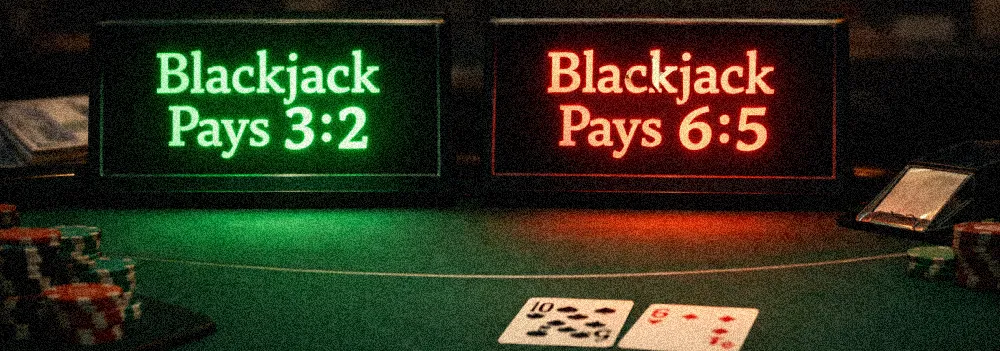
The single most important rule in blackjack is the payout for a natural blackjack. A standard payout of 3:2 means a $100 bet returns $150 when dealt a natural. A reduced payout of 6:5 returns only $120.
That reduction may appear minor, but mathematically it increases house edge by more than one full percentage point. A table that would otherwise offer a 0.5 percent edge can jump to around 1.9–2 percent simply by changing the payout.
This rule alone often matters more than deck count, surrender availability, or doubling flexibility combined. If the game pays 6:5, the baseline mathematics are significantly worse before any other rule is even considered.
Deck Count and Probability Density
Blackjack can be played with one deck, two decks, or multi-deck shoes, commonly six or eight decks. Fewer decks slightly improve player expectation because the proportion of high-value cards changes and the probability of receiving a natural blackjack increases marginally.
In isolation, moving from eight decks to a single deck can reduce house edge by roughly 0.4 to 0.5 percent under identical rule conditions. However, casinos rarely offer generous rule sets in single-deck games. Restrictions are often introduced to offset the structural advantage of fewer decks.
Deck count matters, but it does not determine the whole equation. It interacts with other rules.
Dealer Behavior: Soft 17 and Incremental Edge Shifts
One commonly overlooked rule concerns whether the dealer hits or stands on soft 17. When the dealer hits soft 17, the house edge increases by roughly 0.2 percent. That change sounds minor, but over thousands of hands it becomes meaningful.
Blackjack mathematics operate on narrow margins. Small rule adjustments create compounding long-term effects. The dealer hitting soft 17 increases the dealer’s chance of improving weak hands without increasing bust frequency proportionally, subtly tilting expectation.
Doubling and Splitting: The Value of Flexibility
Player flexibility is a direct lever on expected value. Allowing players to double down on any two cards reduces house edge compared to restricting doubling to specific totals. Permitting double after split improves expectation further because it preserves profitable leverage opportunities.
Similarly, splitting rules affect edge. Being allowed to resplit pairs, especially Aces, slightly reduces house advantage. Restricting splits or prohibiting hitting split Aces shifts the edge back toward the house.
Each of these rule changes may only adjust house edge by tenths of a percent. Together, they accumulate into meaningful structural difference.
Blackjack is a game of marginal adjustments layered on top of one another.
Surrender: Small but Real Impact
Late surrender allows a player to forfeit half the bet after the dealer checks for blackjack. It reduces house edge modestly, often by less than 0.1 percent, but in low-edge games every fraction matters.
Surrender does not transform the game, but it trims long-term loss in specific high-risk scenarios. In tightly optimized rule sets, that trimming contributes to the overall compression of house edge.
The Role of Basic Strategy
Even under ideal rules, the theoretical house edge only applies if the player follows perfect basic strategy. Deviation increases the edge immediately.
Standing when the math says to hit, declining profitable doubles, splitting incorrectly, or habitually taking insurance can push effective house edge above 2 percent even in otherwise favorable games.
Player error often has a larger impact on long-term results than most rule variations. Blackjack offers the possibility of reducing structural disadvantage, but it requires disciplined execution.
Why Rule Combinations Matter More Than Single Variables
Evaluating blackjack quality requires looking at the entire rule set, not one appealing feature. A single-deck game with 6:5 payout is often worse than a six-deck game with 3:2 payout and favorable doubling rules. A table advertising few decks but restricting splits may quietly increase house edge.
The correct approach is to consider how all rules interact to produce a final expected value under optimal play. No single rule defines the edge in isolation.
Long-Term Cost Differences
If a blackjack table offers a 0.5 percent house edge and another offers 2 percent, the difference is not cosmetic. Over $50,000 in wagering volume, a 0.5 percent edge implies roughly $250 in expected loss. A 2 percent edge implies $1,000.
The gap widens with volume. Blackjack players who underestimate rule impact effectively pay a hidden tax over time.
Final Perspective
Blackjack is not inherently the best game in the casino. It is the most adjustable one. Under favorable rules and disciplined play, it offers one of the lowest house edges available. Under poor rules and casual strategy, it can rival far less efficient games.
The difference lies in structure.
The house edge in blackjack is not a single number. It is the product of payout ratios, deck count, dealer behavior, flexibility rules, and player accuracy. Understanding how those variables interact is what separates a low-cost game from an expensive one.
Blackjack does not eliminate the house advantage. It allows the player to compress it.