
Expected Value, RTP Drag, and Why Most Casino Bonuses Are Mathematically Negative
Casino bonuses look generous by design. A 100 percent match up to $500 feels like free leverage. On the surface, it appears that the casino is doubling your money. In reality, the bonus is not capital. It is a conditional instrument tied to wagering volume, time pressure, and mathematical expectation.
To understand whether a bonus is worth taking, you have to ignore the headline percentage and focus instead on expected value.
Most players never calculate it. That is why most players misunderstand what a bonus actually costs.
Bonus Wagering Is Volume – Not Value
When a casino offers a $100 bonus with 35x wagering, the key number is not $100. It is the wagering requirement.
A 35x requirement means you must place $3,500 in total bets before withdrawal becomes possible.
If wagering applies to both deposit and bonus, the required turnover doubles.
This is the point where RTP becomes critical. Every wagered dollar is exposed to house edge. The more volume required, the more expected loss accumulates.
If you are not fully clear on how wagering works structurally, our FAQ section explains it step-by-step in “What is Bonus Wagering?” – including how deposit-plus-bonus wagering differs from bonus-only models.
Understanding this distinction alone can cut your expected loss dramatically.
Expected Value – The Only Number That Matters
Expected value (EV) measures the average mathematical outcome of a decision over time.
If you wager $3,500 on a slot with 96 percent RTP, the theoretical expected loss is 4 percent of total volume.
That equals $140.
So even though you received a $100 bonus, the expected cost of clearing it is $140. Mathematically, you are paying $40 for the privilege of unlocking that bonus.
This is why many bonuses are negative EV propositions.
Players see free money. The math sees forced turnover.
And this calculation assumes:
- You stick to 96 percent RTP games
- You never violate max bet limits
- You clear wagering fully
- You do not hit withdrawal caps
In real-world conditions, the effective RTP during wagering is often lower due to restricted games and bet limitations.
Time Limits Change the Equation
Bonuses are not open-ended. Most come with expiration windows – commonly 7, 14, or 30 days.
Time pressure increases variance exposure. If you attempt to clear wagering quickly, you are increasing bet frequency and accelerating bankroll volatility.
This is where many players move from controlled play to forced play.
On our Bonus Section, we list not only the wagering multiplier but also the validity period. The duration matters as much as the multiplier. A 35x requirement over 30 days is fundamentally different from 35x over 7 days.
Speed changes risk.
RTP Drag During Wagering
Under normal conditions, RTP determines long-term cost. Under bonus conditions, RTP drag accelerates.
Because wagering multiplies betting volume, small differences in RTP compound quickly.
Clearing a 35x bonus on:
- 96 percent RTP
- 94 percent RTP
does not produce the same outcome.
That 2 percent difference across thousands of dollars in turnover can mean the difference between break-even variance and predictable loss.
The problem is that many bonuses restrict high-RTP games. Some table games contribute 10 percent or less. Some slots are excluded entirely. What looks like 96 percent theoretical value can effectively drop below 94 percent during actual wagering.
This is why volume matters more than bonus size.
Variance – The Hidden Risk Multiplier
Even if a bonus is slightly negative EV, players often justify it based on variance potential. The logic is simple: “Yes, expected loss is negative, but I could hit a big win.”
That is true. But variance cuts both ways.
High-volatility slots increase the probability of either:
- Busting before clearing wagering
- Or finishing with surplus profit
Most players underestimate how often the first outcome occurs.
A bonus does not protect your bankroll. It extends exposure.
When a Bonus Makes Sense
There are situations where bonuses are rational:
- Low wagering multipliers
- Bonus-only wagering instead of deposit-plus-bonus
- Long validity periods
- Access to high-RTP eligible games
- No max cashout caps
But these conditions are rare.
This is precisely why we maintain a structured bonus comparison section – not to promote size, but to highlight real wagering requirements and time limits in one place. Surface value is meaningless without structural clarity.
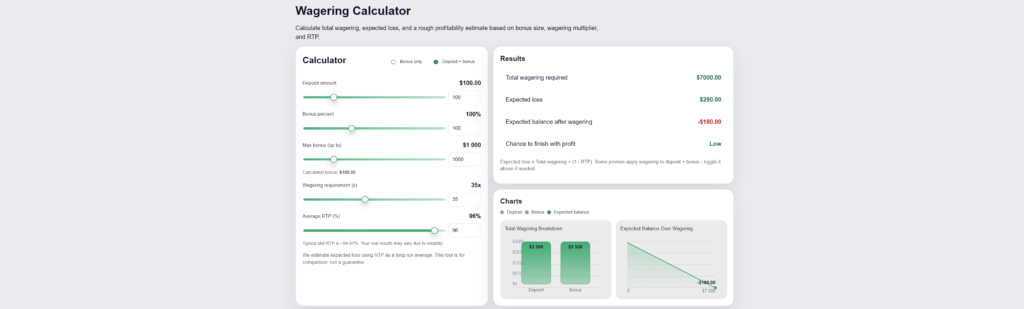
Use the Calculator – Not Emotion
If you want to understand the real cost of a bonus, do not rely on intuition.
Use our Wagering Calculator to input:
- Bonus size
- Wagering multiplier
- Game RTP
It will show you the actual turnover required and the theoretical expected loss. Once you see the total volume in numbers, the psychology shifts immediately.
Bonuses feel different when converted into exposure.
The Psychological Trap
The most dangerous aspect of bonus wagering is not math. It is behavior.
Players feel committed once they start. They increase bet size to clear faster. They switch to higher volatility games chasing acceleration. They ignore stop-loss rules because “I’m close to finishing.”
This emotional escalation turns a slightly negative EV situation into a significantly negative one.
A bonus only works if discipline remains intact. Without it, wagering becomes an amplifier of loss.
Final Perspective
Casino bonuses are not scams. They are structured offers designed around expected value and player psychology.
The house edge remains constant. Wagering multiplies exposure. Time limits apply pressure. Restrictions reduce effective RTP.
When you evaluate a bonus, do not ask:
“How big is it?”
Ask:
“How much volume does it force me to risk?”
Once you shift that perspective, bonus decisions become mathematical rather than emotional.
And in gambling, mathematics always decides the outcome long before emotion realizes it.