
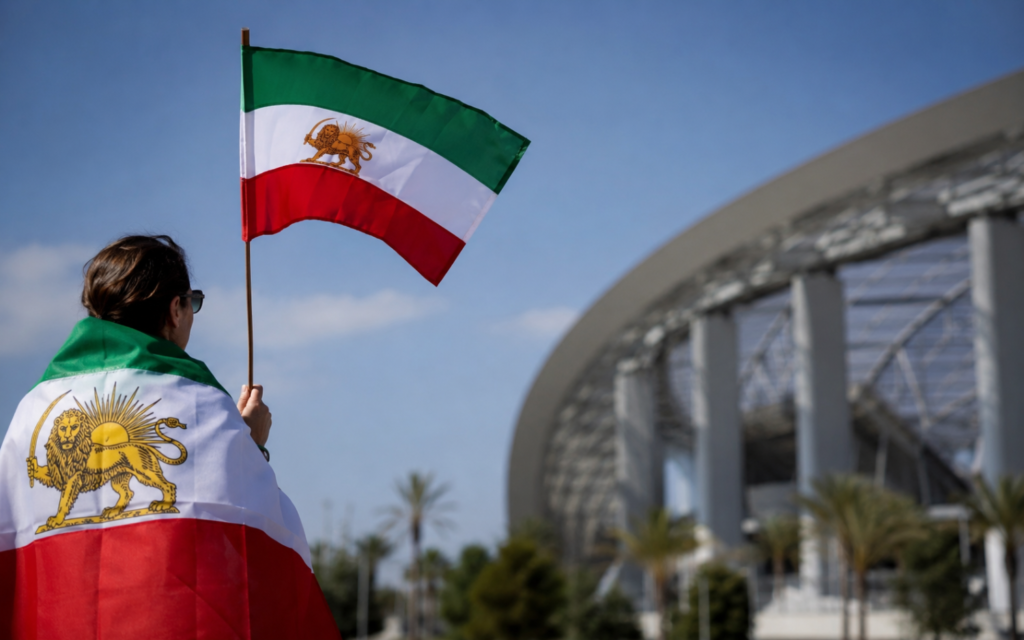
As Iran prepares to begin its World Cup campaign in the United States, political tensions surrounding the national team are already evident far beyond the football pitch.
In Los Angeles, home to one of the largest Iranian communities outside the country, debates over the role of the national team have become deeply intertwined with opposition to the government in Tehran. For many Iranian-Americans, the arrival of Team Melli has reignited long-standing divisions about whether the squad can be separated from the state it represents.
Among those voicing strong opposition is Iranian-American activist Roozbeh Farahanipour, who left Iran in 2000 after years of political activism and now leads the West Los Angeles Chamber of Commerce. Living in the city’s well-known Iranian community of Westwood, often referred to as “Tehrangeles,” he argues that football and politics cannot be viewed independently in Iran’s case.
Farahanipour’s criticism of the Iranian government is rooted in personal tragedy, with family members and friends among those he says lost their lives under the regime. Despite his opposition to Tehran, he also rejects the idea of military conflict, saying innocent civilians should never pay the price for political disputes.
Those conflicting emotions reflect a wider dilemma facing many Iranian football supporters in the United States. While Iran remains a nation passionate about football, this World Cup arrives amid continuing tensions involving Iran, the United States and Israel, as well as sharp disagreements over what the national team symbolizes.
Outside SoFi Stadium in Los Angeles, where Iran will face New Zealand on 15 June, protesters have gathered carrying the Lion and Sun flag, the national flag used before the 1979 Islamic Revolution. For many demonstrators, the symbol represents what they consider the true identity of Iran and serves as a rejection of the current government.
Organiser Arezo Rashidian said the movement is aimed at expressing solidarity with people inside Iran and pushing for political change. Protesters accuse the Islamic Republic of using international sporting events to strengthen its image abroad while suppressing dissent at home.
The demonstrations also reflect lingering anger over anti-government protests earlier this year and the authorities’ response. Protesters point to reports of large-scale casualties and crackdowns during the unrest, arguing that the international community should not ignore those events while Iran competes on the world stage.
Several demonstrators carried signs criticising football’s governing body, FIFA, after the organisation prohibited the Lion and Sun flag from being displayed inside World Cup venues, classifying it as a political symbol under tournament regulations.
Farahanipour and others argue that such restrictions limit freedom of expression, particularly in the United States. Reports have also suggested that the Iranian Football Federation requested respect for the country’s official flag as one of the conditions for participation in the tournament.
Iran’s players have consistently maintained that politics should remain separate from football. However, many protesters say that distinction is impossible to make.
Some expressed sympathy for the players themselves, describing them as talented athletes caught in a difficult situation. At the same time, they argued that wearing the national team’s symbols inevitably links them to the state.
Farahanipour acknowledged the complexity of the issue, saying he respects the players individually while believing they are being used as representatives of the government. He also noted the immense pressure they face competing in a tournament where political scrutiny may be as intense as the football itself.
For many opponents of the Iranian government, any separation between the team and the state would require visible distance from official national symbols, including the country’s anthem and flag.
As Iran prepares to take the field in Los Angeles, football will remain the main attraction inside the stadium. Outside it, however, political tensions are likely to remain impossible to ignore.