
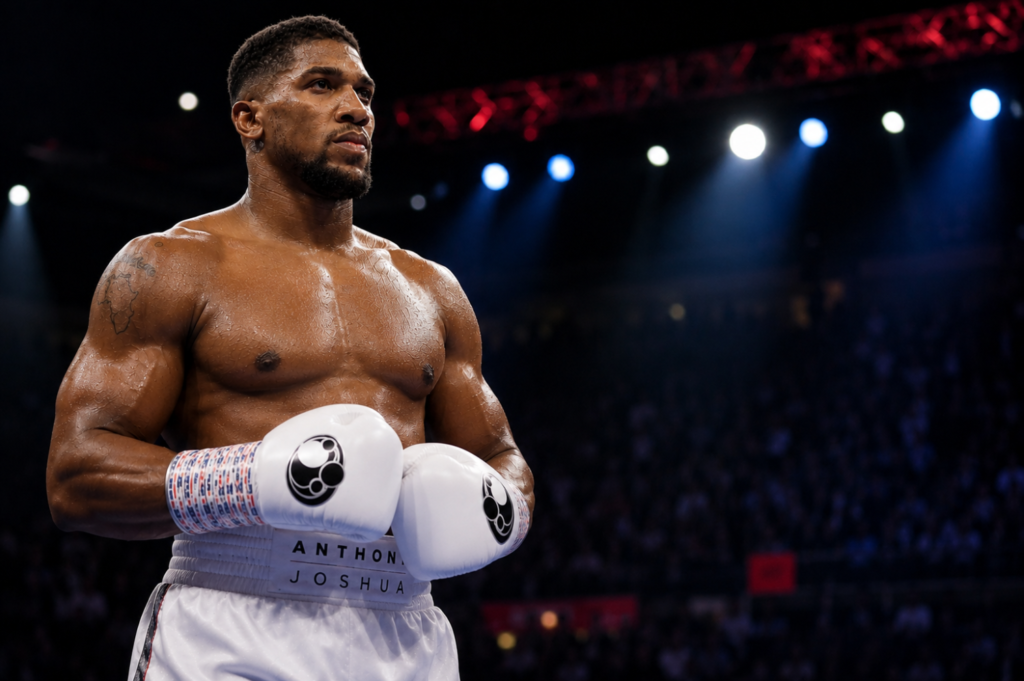
Anthony Joshua’s comeback victory in Saudi Arabia delivered one of the most dramatic nights of his career, preserving hopes of a long-awaited showdown with Tyson Fury while also exposing new concerns about his future at the highest level of heavyweight boxing.
The contest appeared destined for disaster almost immediately. Just 20 seconds into the fight against Albania’s Kristian Prenga, Joshua was floored, and a second knockdown later in the opening round left the former world champion on the brink of a stunning defeat. Instead, he responded with remarkable resilience, regrouping before stopping Prenga in the second round to keep the biggest all-British heavyweight clash alive.
The emotional weight of the victory extended far beyond the result itself. Joshua was fighting for the first time since the tragic car accident in Nigeria that claimed the lives of two close friends, Sina Ghami and Latif “Latz” Ayodele. Simply returning to competition after such a devastating personal loss represented a major achievement.
Even so, the opening round has sparked debate over Joshua’s current level. Prenga entered the fight with an unbeaten knockout-heavy record but had never faced opposition of Joshua’s calibre. His ability to hurt the British star so early has inevitably raised questions about how Joshua would cope against elite heavyweight opponents.
Fight week itself was dominated by Tyson Fury, who once again managed to command attention despite competing elsewhere. Fury moved his own comeback bout against veteran Mariusz Wach to the evening before Joshua’s fight and fuelled speculation over a possible appearance in Jeddah through a series of social media posts before ultimately staying away.
Whether Fury’s presence at ringside would have altered Joshua’s performance is impossible to know. What is clear is that both men emerged from their respective warm-up fights with unanswered questions surrounding their current form.
Fury’s seventh-round victory over the 46-year-old Wach drew criticism from some observers, with many viewing it as little more than a stay-busy contest. However, his earlier performance against Arslanbek Makhmudov in April suggested he still possesses the movement, ring intelligence and tactical discipline that have defined his career.
Joshua’s performance against Prenga, meanwhile, revealed moments of hesitation and vulnerability that Fury has historically been quick to exploit against opponents.
Despite those concerns, Joshua’s achievement should not be judged solely by what happened inside the ring. After the fight, the 36-year-old struggled to hold back emotion while speaking about the friends he lost, underlining the immense personal burden he had carried throughout training camp. His promoter, Eddie Hearn, said boxing had provided Joshua with focus during an extraordinarily painful period and helped him cope with grief away from the spotlight.
Whatever comes next, Joshua’s legacy is already firmly established. An Olympic gold medallist, two-time heavyweight world champion and one of Britain’s biggest sporting figures, he has helped bring boxing to mainstream audiences by selling out stadiums and headlining some of the sport’s biggest events.
Before returning, both Joshua and stablemate Oleksandr Usyk had spoken of ambitions to become undisputed heavyweight champion. Following Saturday’s turbulent victory, however, another world-title reign appears a far more difficult challenge.
That leaves Joshua facing an important decision. Walking away after overcoming personal tragedy and producing one of the most memorable comeback victories of his career would provide a fitting conclusion. Yet the prospect of finally meeting Fury remains irresistible. After years of anticipation, the long-awaited showdown is still the defining fight that has hovered over both men’s careers for almost a decade.