
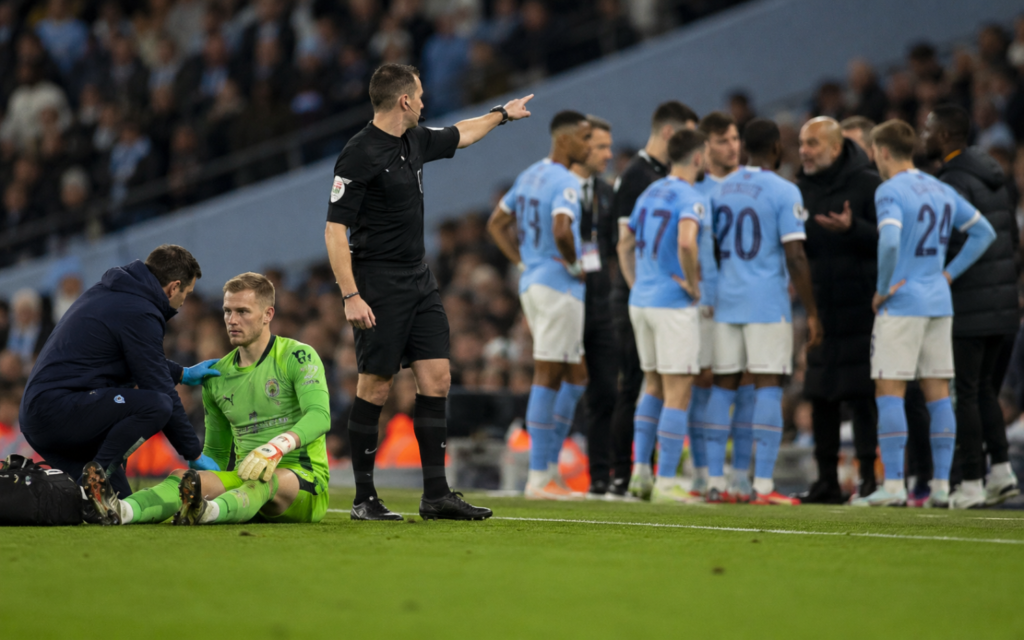
English football will introduce a new rule trial this season aimed at eliminating the growing tactic of goalkeepers deliberately stopping play to allow their teams an unofficial timeout.
The Football Association, Premier League, English Football League, National League and Women’s Super League have all agreed to the experiment after receiving approval from the International Football Association Board (IFAB). The first match to use the rule will be Saturday’s Carabao Cup preliminary-round clash between Tranmere Rovers and Rochdale.
Under the trial, if a referee allows a physio onto the pitch to treat a goalkeeper, the affected team will have to play with 10 players for one minute after play restarts. Coaches will have 10 seconds to nominate an outfield player to leave the field, notifying the fourth official of their choice. If no player is selected within that time, the team captain will automatically leave the pitch.
The measure is designed to prevent teams from using goalkeeper injuries as a way to pause the game, receive tactical instructions and disrupt an opponent’s momentum. In recent seasons, it has become increasingly common for goalkeepers to go down, prompting teammates to gather around the technical area before the keeper quickly resumes play.
The issue drew attention last year when Leeds United manager Daniel Farke accused Manchester City goalkeeper Gianluigi Donnarumma of exploiting the rules by feigning injury to halt the flow of a match.
IFAB chairman of referees Pierluigi Collina identified the problem as a priority earlier this year. During the 2026 FIFA World Cup, officials were instructed to stop players from approaching the technical area during stoppages, although the impact was limited because scheduled hydration breaks still allowed coaches to address their teams.
English football authorities concluded that simply preventing players from gathering near the bench would not be enough. Instead, they opted for a stronger deterrent based on an existing law requiring injured outfield players who receive on-field treatment to leave the pitch briefly before returning.
Former Liverpool and England midfielder Danny Murphy had suggested a similar solution during the previous season, arguing that forcing an outfield player to leave the field instead of the goalkeeper would quickly remove the incentive for tactical stoppages.
Players will still be allowed to move toward the touchline while treatment is taking place, but officials believe the prospect of defending with only 10 players for a minute—particularly in the closing stages of matches—will discourage teams from exploiting the rule.
Several exceptions have been included. A teammate will not have to leave the field if the goalkeeper does not require treatment after stopping play, if the goalkeeper collides with a teammate, is fouled and needs immediate medical attention, is bleeding, or suffers a serious injury or concussion requiring substitution. If the goalkeeper is replaced, the substitution process will not be delayed.
Some concerns have been raised that the rule could encourage injured players to continue playing to avoid leaving their team temporarily short-handed. IFAB will monitor the results of the trial throughout the season, with the findings helping determine whether the change should become part of the Laws of the Game worldwide from the 2027-28 campaign.