
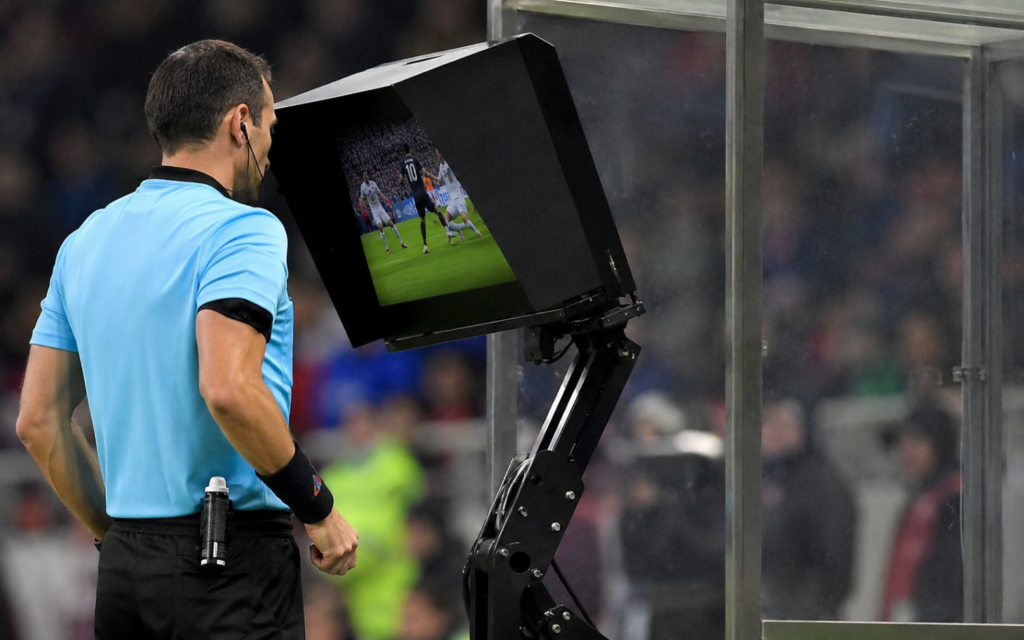
UEFA referees’ chief Roberto Rosetti has called for a more restrained use of VAR across European football, arguing that some recent reviews have become too detached from the way the game is actually played.
His comments came alongside the launch of UEFA’s new Clear Line platform, a public reference tool designed to explain when video officials should intervene and when decisions should remain with the referee on the pitch.
The initiative follows a meeting last month involving senior refereeing representatives from England, Spain, Germany, France and Italy, as well as IFAB technical director David Elleray. The group discussed how to bring greater consistency to decision-making across Europe’s leading competitions.
UEFA’s aim is to reduce highly technical interventions and give more weight to context, speed and the referee’s original judgement. Rosetti believes VAR should focus on obvious errors rather than searching frame by frame for marginal incidents.
Handball remains major source of inconsistency
One of the biggest challenges remains handball, with significant differences between Europe’s leading domestic leagues.
The Premier League had the least frequent handball penalties last season, averaging one every 17.27 matches. Germany’s Bundesliga followed at one every 10.93 games, while La Liga recorded one every 10.56.
Serie A averaged a handball penalty every 10 matches, with Ligue 1 at one every 9.27.
The Champions League was considerably stricter, with a handball penalty awarded on average every seven matches, the highest rate among the competitions compared.
UEFA has included a wide range of handball examples in Clear Line in an effort to demonstrate how officials are expected to apply the laws. However, Rosetti acknowledged that complete uniformity may remain difficult because football cultures and refereeing interpretations differ between countries.
VAR intervention rates also vary considerably.
During the 2025-26 season, the Premier League recorded the lowest intervention rate among major European competitions at 0.29 per match. The Champions League stood at 0.47 interventions per game.
UEFA wants fewer reviews
Rosetti believes the overall number of interventions has become excessive and warned that frequent VAR involvement can influence how players behave, including encouraging them to seek incidents that could trigger a video review.
The intention is to move VAR closer to its original purpose: correcting major and unmistakable refereeing errors rather than reassessing every borderline incident.
UEFA also wants referees to retain greater authority during matches, with video officials stepping in only when the evidence clearly justifies overturning an on-field decision.
Speed has become another key concern.
Lengthy reviews involving repeated slow-motion replays have increasingly frustrated supporters, and UEFA believes checks lasting beyond roughly 90 seconds can undermine confidence in the process.
A revised review procedure has therefore been agreed. When a referee goes to the pitchside monitor, officials will initially see a freeze-frame showing the point of contact, followed by footage at half speed and then at normal speed to assess the true intensity and context of the incident.
The approach is intended to reduce excessive replaying and prevent decisions from being based solely on isolated frames that may exaggerate contact.
Clear Line aimed at fans and clubs
The Clear Line platform covers the main areas in which VAR can become involved, including penalty decisions, red cards, attacking offences, factual decisions and cases of mistaken identity.
Each section contains video examples intended to show how similar incidents are expected to be assessed.
Rather than serving as an internal refereeing manual, UEFA has designed the platform for supporters, players and clubs who want to understand why VAR intervened — or chose not to intervene — in a particular situation.
The wider objective is to make the technology easier to understand while restoring greater responsibility to referees on the field.
UEFA’s message is that VAR should remain a safety net for major errors, rather than becoming the central decision-maker in football matches.