
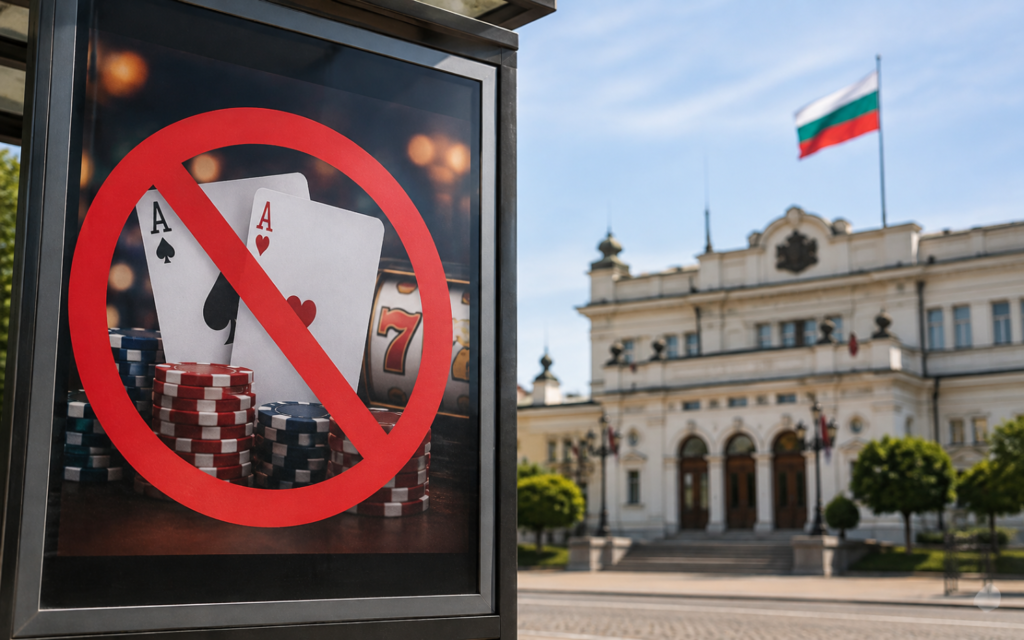
Bulgaria’s We Continue the Change party has submitted legislation that would sharply expand the country’s restrictions on gambling advertising, targeting outdoor promotions, product placement and betting brands embedded in sports sponsorships.
The proposal was filed with Bulgaria’s parliament and would prohibit gambling advertising across television, radio, print, online platforms and social media, while extending the restrictions to virtually all outdoor formats. Bulgarian National Radio reported that the ban would cover billboards, public transport stops, building facades, electronic displays and vehicles.
Only a narrow group of exceptions would remain. Broadcasts of Bulgarian Sports Totalizator draws could continue, while gambling venues would be allowed limited advertising on their own premises. Betting logos on sports clothing intended for adults would also remain possible, but would be capped at 10cm by 10cm.
Party targets gaps in existing restrictions
Bulgaria already introduced extensive gambling advertising controls in 2024. The Gambling Act prohibits advertising in radio and television programming, public areas, printed materials and electronic media, while outdoor billboard advertising is permitted only under specific conditions.
Existing legislation requires permitted billboards to be at least 300 metres from schools, universities, playgrounds, student accommodation and other locations serving children and young people. Bulgaria’s Finance Ministry reaffirmed those requirements in May 2026 while explaining how the outdoor advertising rules are enforced.
We Continue the Change argues that the current framework still allows operators to maintain significant public visibility through forms of branding that are not always treated as conventional consumer advertising.
The debate intensified during coverage of the 2026 World Cup on Bulgarian National Television. Gambling companies including inbet, Efbet and 8888 promoted opportunities to open branded betting shops or enter franchise-style partnerships. Although those campaigns were presented as business offers rather than direct promotions to gamblers, operator branding remained highly visible during television coverage.
Betting brands also remain prominent through Bulgarian football sponsorship. The country’s top division carries the Efbet name, the second tier is sponsored by MrBit, while the domestic cup competition is branded as the Sesame Cup. Such arrangements have become a focus of the political debate because sponsor names can remain visible even where conventional gambling advertising is restricted.
Product placement and sponsorship face tighter limits
The proposed changes would explicitly address product placement and indirect promotional activity. Draft provisions reported in Bulgaria include restrictions on gambling sponsorship of media programmes and a ban on promotional communications involving bonuses, free bets and other gambling incentives.
Permitted advertising would also face stricter responsible gambling requirements. Harm warnings would need to occupy at least 10% of the advertising area and appear clearly in black lettering against a white background.
A 10% responsible gambling warning is already required under Bulgaria’s Gambling Act for several permitted advertising formats. The new proposal is intended to make the presentation requirements more explicit and prevent warning messages from being visually obscured.
The party is also seeking tougher treatment of online gambling promotion. Chairman Assen Vassilev has argued that restrictions should eventually extend beyond Bulgarian legislation, with EU-level measures preventing major digital platforms from serving gambling advertising to users in member states where such marketing is prohibited.
The latest initiative follows earlier efforts by We Continue the Change to tighten gambling rules. Parliamentary records from July 2026 show proposals covering indirect advertising, operator logos, vehicle promotions, bonus communications, sponsorship and product placement.
The new bill must now pass through Bulgaria’s legislative process, including parliamentary committee scrutiny, before it can reach a final vote. If adopted, it would significantly reduce the remaining ways licensed gambling companies can display their brands outside their own venues and would place Bulgaria among Europe’s more restrictive markets for betting advertising.