
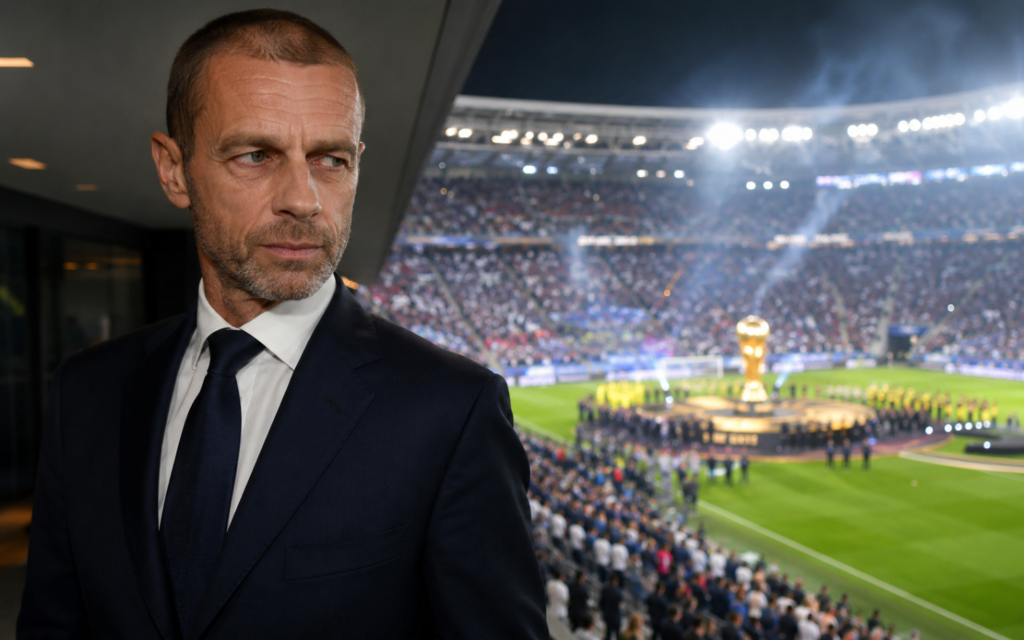
Uefa president Aleksander Ceferin stayed away from the World Cup final between Argentina and Spain amid growing disagreement with Fifa and several decisions introduced during the tournament.
Ceferin attended the opening match in Mexico City between co-hosts Mexico and South Africa, but chose not to travel to New Jersey for Sunday’s final.
One of the main reasons was Fifa’s handling of the disciplinary case involving United States striker Folarin Balogun. The forward avoided suspension following an intervention by US President Donald Trump, a decision Uefa described as unprecedented and unjustifiable.
European football’s governing body warned that inconsistent enforcement of regulations threatened both the integrity of the sport and the credibility of major competitions.
Ceferin has also opposed several initiatives promoted by Fifa president Gianni Infantino, including the introduction of extended half-time entertainment. The World Cup final featured performances by Madonna, BTS, Shakira and Justin Bieber, increasing the interval from the usual 15 minutes to 27 minutes and 22 seconds.
Uefa has no plans to introduce similar shows at the Champions League or European Championship. The organisation is also against expanding the World Cup to 64 teams, an idea Infantino appeared willing to consider during the tournament.
Relations were further strained after Somali referee Omar Artan was denied entry to the United States before the competition. Uefa later invited Artan to officiate the Super Cup between Paris Saint-Germain and Aston Villa on 12 August.
Ticket pricing has also become a source of disagreement. Uefa is expected to keep Euro 2028 prices broadly unchanged, offering significantly cheaper access than the World Cup, where some stadium parking spaces reportedly cost as much as five European Championship tickets.
There are also differences over the interpretation of new disciplinary protocols.
Unlike Fifa, Uefa has instructed video assistant referees not to treat simulation as grounds for intervention under mistaken-identity rules. Fifa’s approach contributed to Switzerland striker Breel Embolo being dismissed during the quarter-final defeat by Argentina.
Players who cover their mouths while confronting opponents will also not automatically receive red cards in Uefa competitions.
The issue gained attention in February when Benfica winger Gianluca Prestianni pulled his shirt over his mouth while speaking to Real Madrid forward Vinicius Jr during a Champions League match.
Prestianni was initially accused of racist abuse and provisionally suspended for one game. A later Uefa investigation found him guilty of homophobic conduct and imposed a six-match ban, with three matches suspended.
The automatic red-card measure was promoted by Infantino as a deterrent for misconduct at the World Cup.
Paraguay midfielder Miguel Almiron became the first player dismissed under the rule during a group-stage match against Turkey. Arsenal defender Piero Hincapie was later sent off during Ecuador’s last-16 defeat by co-hosts Mexico.
Ceferin’s absence from the final highlighted the widening divide between football’s two most powerful governing bodies over discipline, tournament expansion, commercial presentation and supporter costs.