
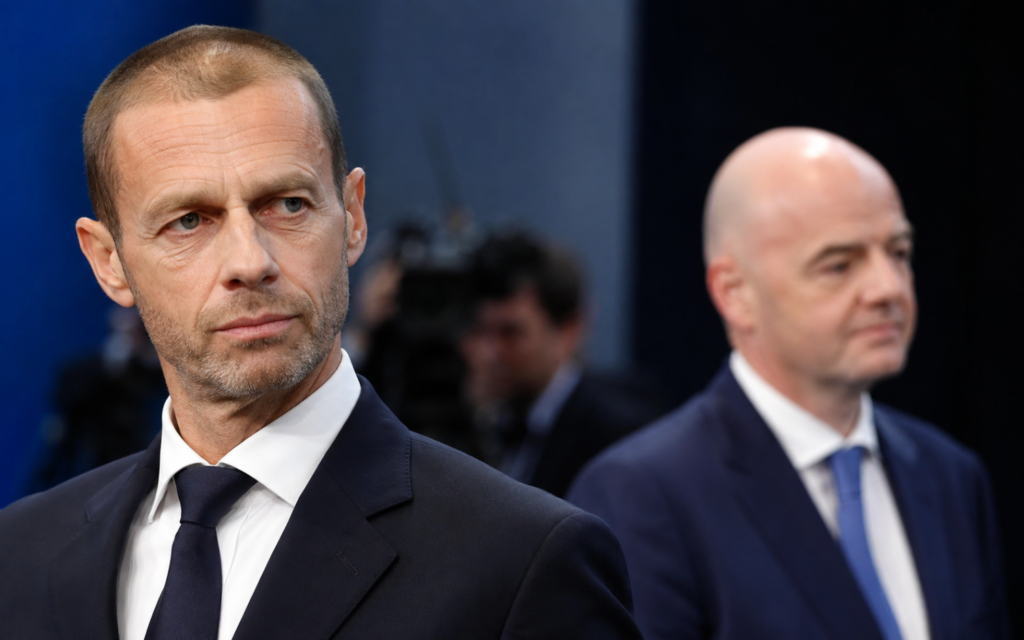
UEFA president Aleksander Ceferin has ruled out challenging Gianni Infantino for the FIFA presidency, but believes the incumbent could face an opponent when football’s world governing body holds its next election in March 2027.
Infantino has come under growing pressure after abandoning a plan that would have opened part of FIFA’s commercial operation to private investment. The proposal triggered fierce resistance from UEFA and several national associations, with European members threatening to boycott future World Cups if it went ahead.
Ceferin, 57, had been widely discussed as a possible rival to Infantino, but he has now made clear that he intends to remain focused on UEFA rather than seek FIFA’s top position.
He indicated that staying outside the race also strengthens his ability to criticise FIFA’s leadership independently.
Infantino could face election challenge
Ceferin believes the dispute has significantly weakened Infantino’s standing across the international game.
According to the UEFA president, one possibility is that Infantino decides not to seek another term after recognising that he lacks sufficient backing from the wider football community. Alternatively, Ceferin expects another candidate to emerge ahead of the March election.
He said he is not currently aware of who that challenger could be.
The controversy centres on the abandoned FIFA Forward Enterprise project, which would have created a new company controlling commercial and ticketing rights across FIFA competitions. Under the proposal, a 21% stake would have been sold to a private investment group.
The plan was eventually dropped following mounting opposition.
UEFA, Concacaf and the Asian Football Confederation subsequently issued a joint open letter accusing FIFA’s leadership of damaging trust over the way the proposal had been handled.
Several national associations have since withdrawn their support for Infantino, including all four UK home nations. However, he continues to receive backing from South American confederation Conmebol and African governing body CAF.
Infantino seeks international backing
Infantino, 56, previously spent 16 years at UEFA and served nine years as its general secretary before becoming FIFA president.
In recent weeks, he has travelled internationally as he attempts to reinforce support for his leadership.
He met representatives of the Caribbean Football Union in the Dominican Republic on Saturday before appearing at the E-Sports World Cup in Paris the following day. The Paris event was also attended by French President Emmanuel Macron, Saudi Crown Prince Mohammed bin Salman and Portugal captain Cristiano Ronaldo.
Ceferin has criticised Infantino’s approach during the dispute and argued that the proposed commercial restructuring represented an even more serious threat to football than the failed European Super League project.
The Super League was announced in April 2021 as a proposed breakaway competition involving some of Europe’s biggest clubs, but collapsed within days after widespread opposition from supporters, governing bodies and governments.
Ceferin said UEFA had not been informed about FIFA’s investment proposal in advance and that he first learned about it through media reports while away with his family.
He believes the plan would have transferred too much control over major football assets to private investors and is confident it will not be revived.
Trump relationship adds to scrutiny
Pressure on Infantino had already been building before the FIFA Forward Enterprise dispute because of his relationship with US President Donald Trump.
The issue intensified during this summer’s World Cup after United States striker Folarin Balogun had a red-card suspension overturned before his country’s last-16 defeat by Belgium.
Trump later said he had personally contacted Infantino and asked him to examine the sanction.
The revelation raised questions about FIFA’s independence and disciplinary procedures, despite the organisation maintaining that the decision had been made independently.
Earlier in August, Trump publicly defended Infantino and said removing him from the FIFA presidency would be a serious mistake.
Ceferin described political involvement in disciplinary matters as deeply damaging to confidence in football governance. He argued that FIFA must apply its own regulations consistently and remain protected from outside influence.
With the March 2027 FIFA Congress approaching, Infantino’s position now appears increasingly dependent on whether he can rebuild support among national associations and the broader football community.
Ceferin will not be among his challengers, but the UEFA president expects Infantino’s leadership to face a significant test before the next election.