
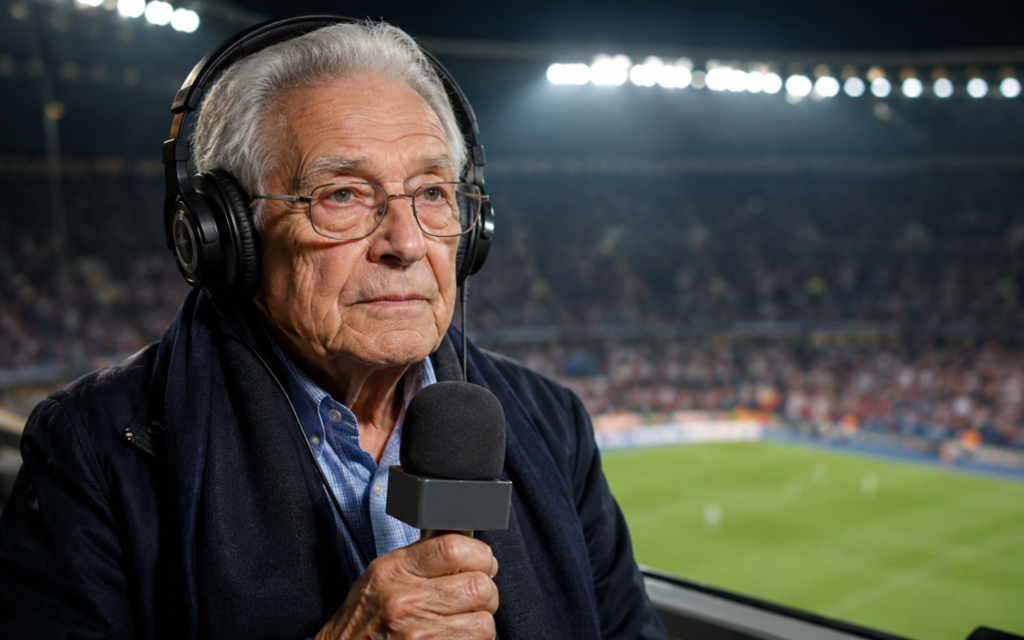
For nearly seven decades, Enrique “Macaya” Marquez has witnessed football’s greatest moments from the sidelines, earning a place in World Cup history that few are ever likely to match.
Now 91, the veteran Argentine broadcaster is covering his 18th consecutive FIFA World Cup, a remarkable run that began in Sweden in 1958. Over the course of his career, he has reported on icons ranging from Pele and Diego Maradona to Lionel Messi, while watching the sport evolve from a largely regional spectacle into one of the world’s biggest global events.
Macaya’s first World Cup assignment came at the age of 24, when he travelled to Sweden to cover the tournament. One of his earliest memories was not Brazil’s emerging teenage star Pele, but Argentina’s crushing 6-1 defeat to Czechoslovakia in what became known at home as the “Disaster of Sweden.”
The defeat left a lasting impression because Argentina entered the match with little knowledge of their opponents, who caught them completely off guard.
Despite the dramatic changes in football over the decades—from digital broadcasting and advanced analytics to the expansion of the World Cup itself—Macaya says one principle has never changed in his approach to journalism: avoiding snap judgments.
That mindset influenced his reaction when Lionel Scaloni was unexpectedly appointed Argentina manager in 2018. Like many observers, Macaya admitted he had doubts because Scaloni was largely unknown at senior international level.
Since then, Scaloni has transformed Argentina into one of world football’s dominant teams, guiding the nation to Copa America, Finalissima and FIFA World Cup titles. For Macaya, the coach’s success reinforced the importance of understanding people fully before reaching conclusions about them.
Argentina are now preparing for another World Cup semi-final, where they will face England on Wednesday, with a place in the final at stake.
Macaya believes the reigning champions are fully capable of lifting the trophy once again.
Asked about his favourite Argentina player, he immediately points to Messi. However, when the discussion turns to football’s greatest player of all time, his answer becomes more cautious.
Rather than ranking players across generations, Macaya argues that football has changed too much for fair comparisons. Different eras, opponents, tactical systems and teammates make it impossible to judge legends by the same standards.
He applies the same reasoning when discussing Messi and Maradona, saying each player’s career was shaped by unique circumstances. Likewise, he refuses to compare Pele’s Brazil side that won the 1970 World Cup with Maradona’s victorious Argentina team of 1986, describing them as products of completely different styles and periods.
Looking back across almost 70 years of tournaments, Macaya says defeats remain just as memorable as victories. While Argentina’s World Cup triumphs naturally stand out, he believes setbacks also become part of football’s lasting history.
Among his fondest memories are Argentina’s World Cup victories, particularly Maradona’s triumph in 1986, which he believes fulfilled the legendary captain’s lifelong ambition of becoming a world champion.
After covering an unprecedented 18 straight World Cups, Macaya acknowledges that retirement is approaching. Although he jokes about stepping away from broadcasting, his farewell carries the same measured tone that has defined one of football journalism’s longest and most distinguished careers.