
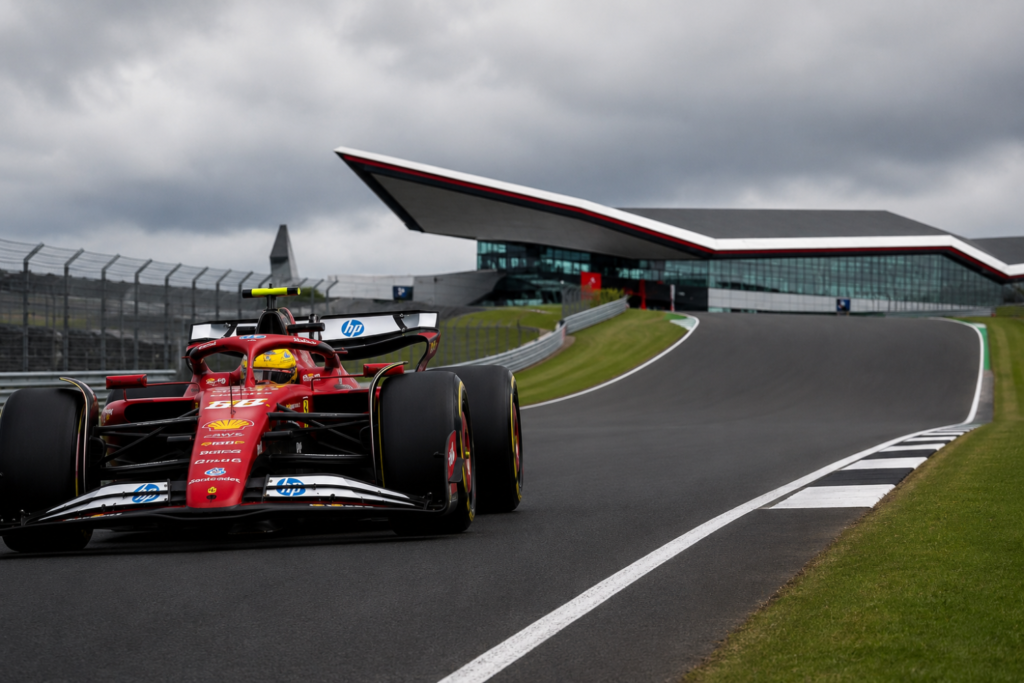
Lewis Hamilton believes Silverstone will feel like a very different circuit this year as Formula 1’s new generation of cars faces a unique challenge at the British Grand Prix.
The Ferrari driver said the famous high-speed layout will expose issues with power deployment, with drivers expected to lose electrical energy through some of the most iconic sections of the track.
Silverstone is known for its fast corners and flowing nature, but the limited number of braking zones means cars have fewer opportunities to recover energy. As a result, drivers could be left relying mainly on the internal combustion engine in key areas.
This year’s power units are designed with a much greater balance between electric and combustion performance, producing around 350kW from the battery system and slightly more than 400kW from the engine. However, long full-throttle sections mean electrical power can run out before the end of a lap.
Hamilton explained that corners such as Copse, Maggotts and Becketts, traditionally among the most exciting parts of Silverstone, will not have the same feeling because drivers will need to manage energy rather than push flat out throughout the sequence.
The seven-time world champion also warned that Ferrari could face a bigger performance gap to Mercedes than at the Austrian Grand Prix because of Silverstone’s characteristics. Ferrari’s engine package currently produces less power than Mercedes and Red Bull, limiting how much energy can be recovered.
Other drivers have also raised concerns. Aston Martin’s Fernando Alonso described the situation as disappointing for both competitors and fans, pointing out that losing electrical deployment significantly reduces overall performance.
However, Mercedes driver George Russell believes the changes could have an upside by creating more unpredictable racing. He said previous races affected by energy management, including Melbourne, produced strong on-track battles and suggested many spectators watching from the stands may not notice the difference.
Russell added that the issue has been influenced by the FIA’s decision not to permit straight-line mode in some areas of Silverstone. The system, which reduces drag by opening the front and rear wings, will not be available between Turn One and Turn Three or from Copse towards Becketts because of safety concerns.
A proposal to reverse the decision was discussed before the race weekend, but all teams needed to support the change and five of the 11 competitors voted against it.
Russell said Mercedes supported allowing the system despite potentially benefiting from the current restrictions, arguing that simulations showed it would improve the overall driving experience.
Formula 1 has already approved adjustments for future seasons aimed at improving the balance between combustion and electric power, which should reduce similar energy issues at circuits like Silverstone.