
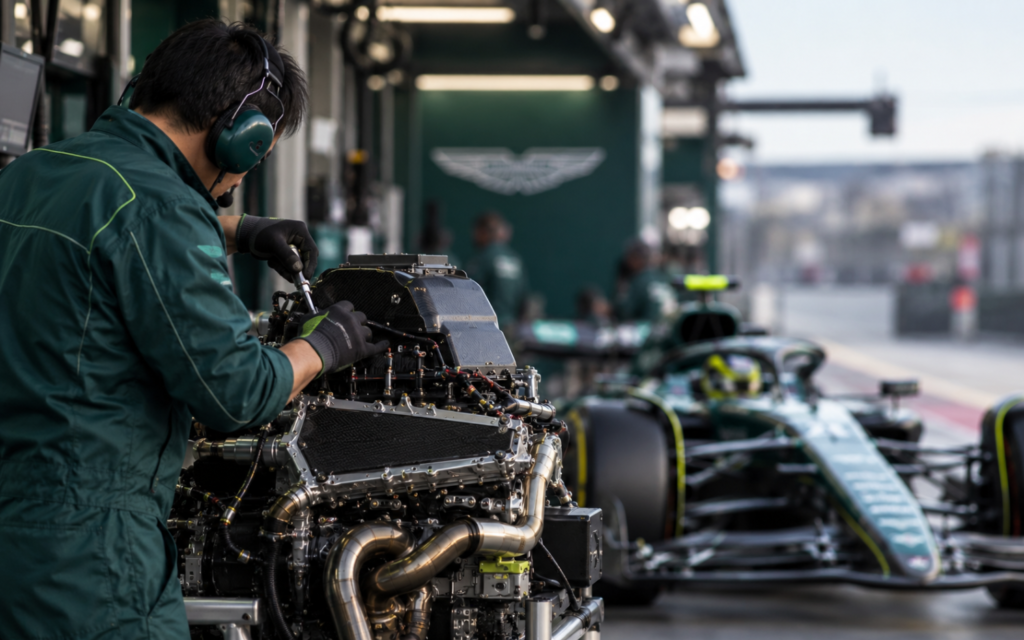
Honda has reorganised the leadership of its Formula 1 power-unit programme as it looks to recover from a difficult opening season with Aston Martin.
The Japanese manufacturer returned to F1 as an official works supplier in 2026, beginning a new partnership with Aston Martin after previously powering Red Bull to four consecutive drivers’ titles with Max Verstappen between 2021 and 2024.
That success has not carried over into Honda’s latest project. Aston Martin currently sits 10th in the 11-team constructors’ championship, with Fernando Alonso’s ninth-place finish at the Dutch Grand Prix standing as the team’s best result so far.
Honda changes F1 engine leadership
Honda has promoted Yoichiro Fukao to the role of Large Project Leader for its Formula 1 programme. Fukao had previously served as deputy project leader and takes over from Tetsushi Kakuda, who had been overseeing development of the company’s 2026 power unit.
The manufacturer said the change forms part of a planned succession process intended to pass technical knowledge to a new generation of engineers while strengthening its development structure ahead of further regulatory changes expected from 2027.
Honda introduced its first engine upgrade of the season at the Dutch Grand Prix. Although internal data showed an improvement, the gain was understood to be modest and below the level Aston Martin had hoped for.
The power unit is believed to be costing the team at least one second per lap when losses from both the combustion engine and electrical systems are combined.
That shortfall is particularly significant under Formula 1’s 2026 engine regulations, which place much greater emphasis on electrical power. The new-generation units deliver an almost equal split between combustion and electric output, making efficient energy recovery and deployment critical throughout a lap.
The scale of Aston Martin’s current deficit was again visible at the Spanish Grand Prix. Alonso was eliminated in the first phase of qualifying after finishing 2.2 seconds away from the session’s quickest time.
Honda rebuilding after disrupted F1 exit
Honda’s problems are closely linked to the complicated path that preceded its latest F1 return.
The company announced in October 2020 that it would leave the championship after the 2021 season. It continued supplying Red Bull with engines in a reduced capacity through the end of 2025, but much of its Formula 1 engineering workforce was reassigned to other areas of the business.
Honda remained competitive during that period partly because engine development was heavily restricted under the technical regulations in force from 2021 to 2025.
When the manufacturer decided in May 2023 to make a full works return for 2026, it had to rebuild much of its development operation. Rather than immediately restoring the group responsible for its successful 2021 engine, Honda brought engineers with limited or no previous Formula 1 experience into the programme.
That approach has contributed to a challenging start under the new rules. Honda has since begun bringing experienced personnel back into its F1 operation in an effort to speed up development and close the performance gap.
Alonso faces another difficult Honda chapter
The situation is particularly familiar for Alonso. The two-time world champion endured three difficult seasons with Honda-powered McLaren between 2015 and 2017, when the manufacturer struggled badly after returning to Formula 1 following an earlier absence.
Honda’s latest restructuring also comes at an important point in Alonso’s career. The Spaniard has yet to confirm whether he will remain in Formula 1 beyond the end of the 2026 season, when his current Aston Martin contract expires.