
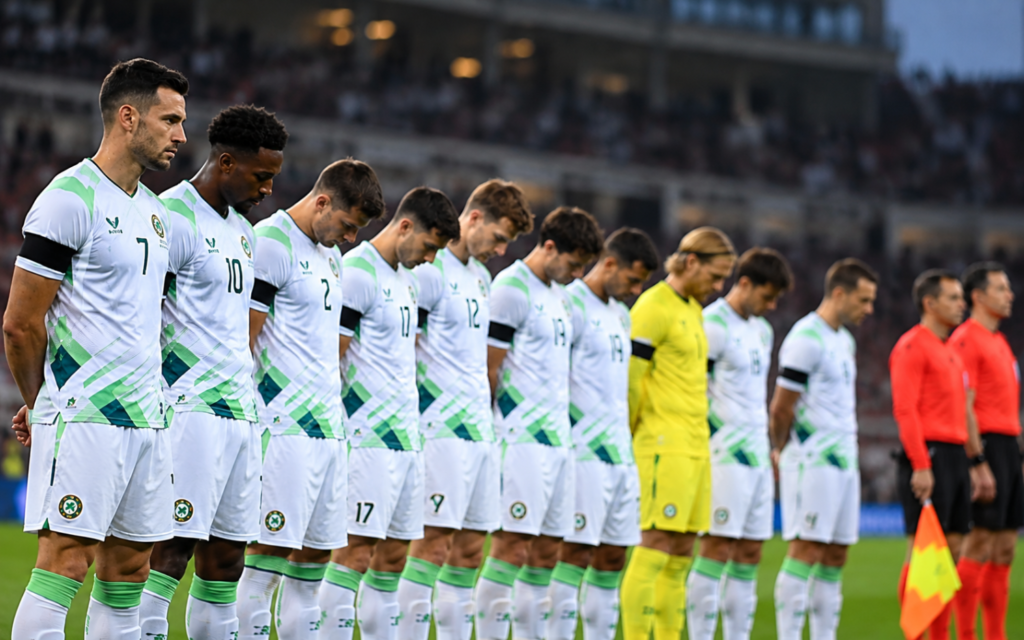
Republic of Ireland head coach Heimir Hallgrimsson said his squad had brought international attention to the controversy surrounding their Nations League fixtures against Israel after the players declined to take part in several pre-match formalities before a 3-0 victory in Debrecen.
Ireland and Israel did not exchange handshakes before Sunday’s match in Hungary, while the Irish players bowed their heads during the Israeli national anthem. Captains Dara O’Shea and Manor Solomon also did not shake hands or exchange pennants.
Ireland’s players wore black armbands during the match. The Football Association of Ireland said the gesture was intended to recognise those who have lost their lives in the Gaza conflict. Jack Moylan, who scored Ireland’s third goal, removed his armband after scoring and kissed it before kissing the Ireland badge.
The game ended in a convincing 3-0 Irish victory, giving Hallgrimsson’s team their first points of the Nations League campaign after an opening defeat by Kosovo.
Players Vote to Fulfil Fixture
The match had been in doubt less than 24 hours before kick-off following lengthy discussions involving Ireland’s players.
Goalkeeper Gavin Bazunu withdrew from the squad after deciding he did not want to participate in either Nations League fixture against Israel. His decision was followed by an extended team meeting at Ireland’s hotel on Saturday, which delayed both training and a scheduled media conference.
The squad eventually voted to fulfil the fixture, with the FAI confirming that a majority of players wanted the game to proceed.
Hallgrimsson said the different positions taken by his players had been respected and that their actions surrounding the match had already drawn significant attention to the issue.
Bazunu will remain available for Ireland’s match against Austria in Dublin on Thursday but will not participate in the second Israel fixture on 4 October. Hallgrimsson said the goalkeeper’s withdrawal did not affect how the starting team against Israel was selected, with sporting considerations determining the line-up.
The return fixture will take place behind closed doors in Bačka Topola, Serbia, after the FAI moved the match away from Dublin because of operational concerns. UEFA approved the neutral venue earlier this year.
Boycott Pressure Builds Around Fixtures
The Ireland-Israel games have generated controversy since the countries were drawn together in Nations League Group B3 in February.
Campaign group Irish Sport for Palestine has urged Ireland not to play the fixtures, with more than 160 Irish athletes reported to have supported an open letter calling for a boycott.
The FAI nevertheless maintained that withdrawing could have serious sporting and financial consequences. Under UEFA competition rules outlined by the association, refusing to fulfil the matches could result in forfeited points, further disciplinary action and possible damage to Ireland’s rankings and Euro 2028 qualifying position.
The association had previously backed a motion seeking Israel’s suspension from UEFA competitions, while an FAI extraordinary general meeting in July supported proceeding with the Nations League games.
Sunday’s match was played with only a small crowd. Ireland supporters had not been allocated tickets, although several Irish fans were seen inside the stadium. Irish players were also jeered by some Israel supporters when they came out for the warm-up. Reports from the venue put the Israel attendance at around 100.
War in Gaza Remains Central to Dispute
The controversy surrounding the fixtures comes against the continuing consequences of the Israel-Gaza war.
Hamas-led militants attacked Israel on 7 October 2023, killing about 1,200 people and taking 251 hostages. Israel responded with a military campaign in Gaza. UN reporting has cited Gaza’s Ministry of Health as saying more than 73,000 Palestinians have been killed since the start of the war, while noting that casualty figures are attributed to their respective sources.
Israel has rejected accusations that its military campaign amounts to genocide and has maintained that its operations have been carried out in self-defence and in accordance with international law.
Ireland’s second Nations League meeting with Israel is scheduled for 4 October in Serbia, three days after Hallgrimsson’s side host Austria at the Aviva Stadium.