
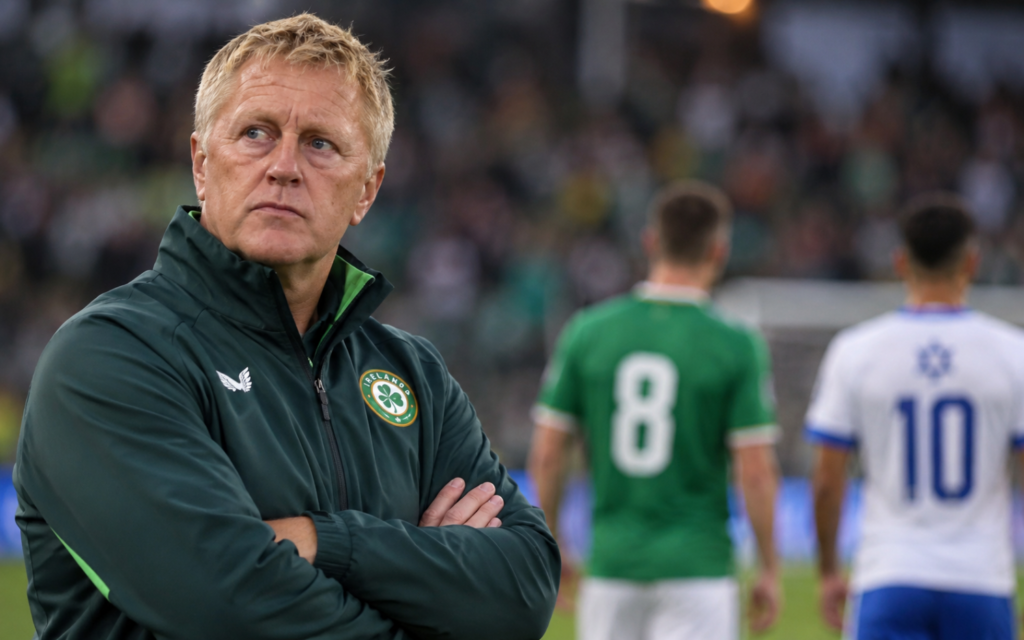
The Israel Football Association has criticised Republic of Ireland manager Heimir Hallgrimsson over his comments about the upcoming Nations League matches between the two countries, as calls for Ireland to boycott the fixtures continue to grow.
Hallgrimsson addressed the controversy during last week’s squad announcement, explaining that Ireland would be competing against Israel rather than supporting the country’s actions in Gaza. He also acknowledged the discomfort surrounding the matches, revealing that he had spoken individually with his players and that none felt comfortable about the prospect of facing Israel.
The Israeli football body responded on Monday with a social media statement accusing the Icelandic coach of ignorance, hypocrisy and stupidity. It defended Israel’s contributions to science and humanity while directing personal criticism at Hallgrimsson.
The Football Association of Ireland (FAI) has not publicly responded to the statement.
The dispute comes amid renewed pressure on the Irish team to withdraw from the two fixtures. Protesters gathered outside the squad’s hotel on Monday evening, while more than 160 Irish athletes and former sportspeople have signed an open letter demanding a boycott.
The appeal, organised by Irish Sport for Palestine, calls on the FAI, UEFA and the Irish government to intervene before the matches take place.
Among the signatories are Olympian Ciara Mageean, former Ireland footballer Louise Quinn, former rugby international Tony Ward and boxers Tyrone McKenna and Eric Donovan.
Several prominent Gaelic games figures have also supported the initiative, including Joe Brolly, Colm O’Rourke, Padraig O’Hora, Philly McMahon, Michael Darragh Macauley, Valerie Mulcahy and Rena Buckley.
Para-athlete Alan Dineen and ultimate frisbee player Stephen Jones, both of whom previously boycotted fixtures against Israel, have also signed.
The letter argues that refusing to participate would demonstrate solidarity with Palestinians and reflect Ireland’s sporting traditions and historical opposition to colonialism. Its signatories believe that withdrawing from the matches would send a message extending beyond football.
The controversy follows the war in Gaza, which began after Hamas attacked Israel on 7 October 2023, killing approximately 1,200 people and taking 251 hostages. Israel subsequently launched a military offensive in Gaza that has killed more than 70,000 Palestinians, according to figures cited by the United Nations.
Israel has repeatedly rejected allegations of genocide and war crimes, maintaining that its military campaign is an act of self-defence.
Despite the boycott campaign, the FAI has already decided that Ireland should fulfil the fixtures.
At its General Assembly in July, a motion supporting participation received 75 votes, with 32 against and three abstentions. The association had previously warned that withdrawing could cause substantial long-term damage to Irish football, including a potential financial loss of €10.3 million (£9 million).
Ireland are scheduled to face Israel in Hungary on 27 September, with the second match taking place in Serbia on 4 October.
The fixtures will be Ireland’s first competitive appearances since their World Cup play-off semi-final defeat by the Czech Republic in March, when they lost on penalties in Prague.
Hallgrimsson’s side have since played four friendlies, recording victories over Grenada and Qatar and draws against North Macedonia and Canada.