
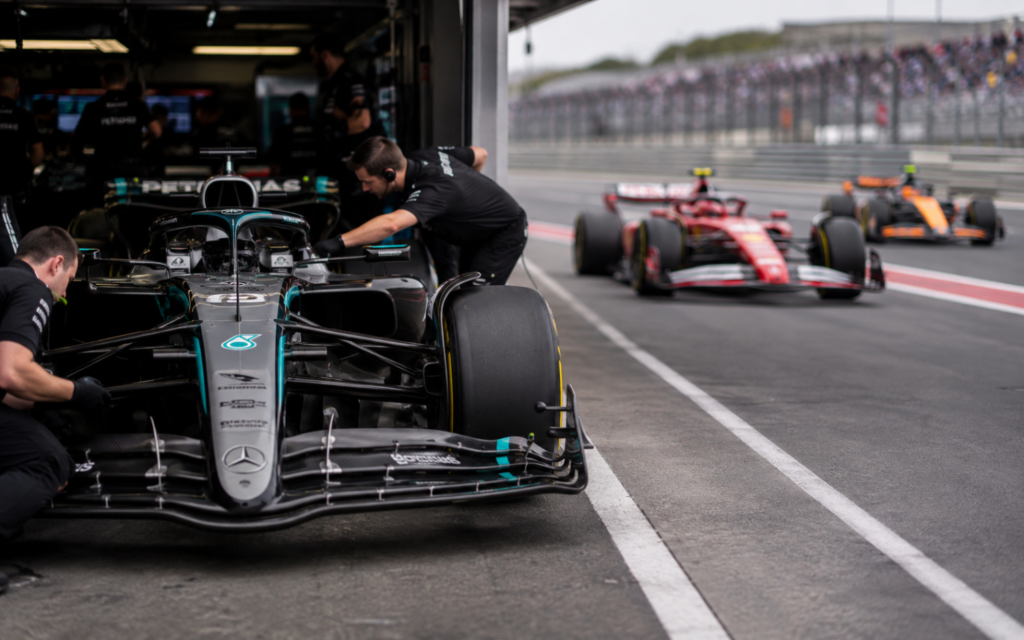
Mercedes team principal Toto Wolff has admitted the championship leaders are being forced to carefully manage their development budget as Ferrari and McLaren close the performance gap in the second half of the Formula 1 season.
Mercedes dominated the opening phase of the campaign by winning the first six races, but the competitive picture has changed significantly since then. Ferrari and McLaren have each taken two victories across the following six rounds, helped by a steady stream of upgrades.
Lando Norris strengthened McLaren’s resurgence with victory at the Dutch Grand Prix, his second consecutive win. McLaren introduced further updates at Zandvoort after already bringing a substantial package to the previous race in Hungary, while Ferrari also arrived in the Netherlands with new components.
Ferrari had previously upgraded its car at the Spanish Grand Prix in June. Mercedes, by comparison, has not introduced a major development package since the Canadian Grand Prix, which was the fifth race of the season.
Mercedes Balances Spending Across the Season
All Formula 1 teams operate under the same $215 million cost cap, but Wolff explained that Mercedes has chosen to distribute its available development resources across the full campaign rather than concentrate spending in a shorter period.
The team is attempting to identify the races where upgrades can deliver the greatest championship benefit while remaining within its financial limits. Wolff acknowledged that every significant package introduced by a leading team can potentially add several tenths of a second in performance, meaning Mercedes risks losing ground whenever its rivals bring successful updates.
That approach has contributed to a more difficult period after the team’s dominant start.
Kimi Antonelli nevertheless limited the damage at Zandvoort by finishing second behind Norris. The Mercedes driver remains 59 points ahead of team-mate George Russell and Ferrari’s Lewis Hamilton in the championship, while Norris is 83 points behind.
Mercedes’ next substantial upgrade is not expected for another four races, with the team targeting a later round for its next major development step.
Antonelli Set for Engine Penalty at Monza
Before that upgrade arrives, Mercedes is preparing for Antonelli to take a grid penalty at the Italian Grand Prix.
The team plans to introduce a new power unit at Monza that would take the championship leader beyond his permitted engine allocation for the season.
Mercedes believes the Italian circuit is the most suitable venue for the penalty because its long straights increase the benefit of a fresh engine, while the track also offers better overtaking opportunities than several other venues.
The fact that Monza is Antonelli’s home race does not appear to have changed Mercedes’ calculations. The team is prioritising the championship impact of the decision over the promotional value of giving its Italian driver the best possible starting position in front of his home crowd.
McLaren Questions Mercedes’ Upgrade Claims
Mercedes’ relatively limited number of upgrades has attracted attention from rival teams, particularly because Ferrari, McLaren and Red Bull have all introduced more new components during the season.
McLaren team principal Andrea Stella has questioned the suggestion that Mercedes has little remaining capacity for major developments.
Teams agreed to an additional $3 million cost-cap allowance that can be used across 2026 and 2027, followed by another $3 million covering 2027 and 2028. The adjustment was introduced because future power-unit regulations could require additional chassis work, particularly as changes to fuel requirements affect car design.
Stella expects Mercedes to have significant performance improvements under development despite the lack of recent upgrades on the race car.
McLaren’s view is that Mercedes is likely already seeing stronger numbers from its wind-tunnel programme and could eventually convert those gains into new components for upcoming races.
With Ferrari and McLaren increasing the pressure and Norris building momentum, Mercedes now faces a different challenge from the one it encountered during its dominant opening six races. The team’s ability to time its remaining upgrades effectively could become increasingly important as the championship enters its decisive phase.