
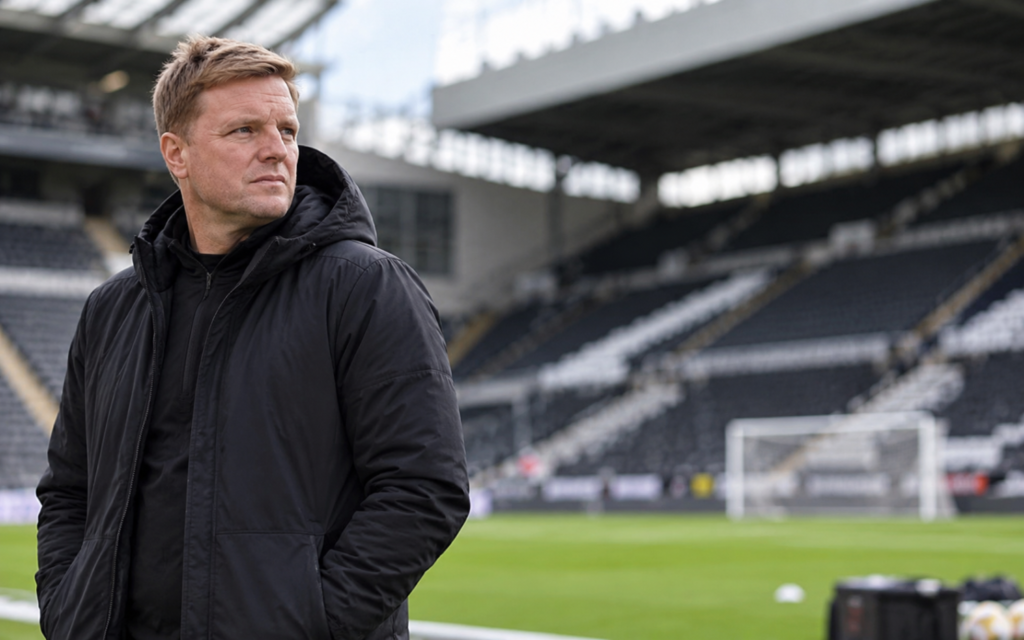
Newcastle United had been preparing for the possibility of Eddie Howe leaving the club for much of the past year, sporting director Ross Wilson has revealed, allowing the Magpies to move quickly when the head coach stepped down in July.
Howe had initially expected to remain in charge for the new season, but after almost five years at St James’ Park he decided he needed time away from management. His departure came during a summer already marked by major changes to Newcastle’s squad.
Despite the timing, Wilson insists the club were not caught unprepared. Newcastle had been assessing possible successors for around eight or nine months, with Matthias Jaissle among the coaches under consideration well before the position became vacant.
Jaissle Fit Newcastle’s Long-Term Football Plan
Newcastle spoke to several candidates after Howe’s departure before identifying Jaissle as their preferred option.
The club wanted a coach capable of preserving the aggressive, high-intensity style developed during Howe’s tenure rather than introducing an entirely different football identity.
Jaissle’s record of developing younger players was another important factor. His previous work at Red Bull Salzburg matched Newcastle’s recruitment strategy, which increasingly focuses on players aged 24 or younger who can improve while retaining future transfer value.
Wilson’s first conversation with Jaissle strengthened the club’s interest, and the sporting director quickly became convinced that the German was the strongest candidate.
Jaissle eventually moved to Newcastle from Saudi Pro League side Al-Ahli and has made an encouraging start, remaining unbeaten through his first four matches in all competitions.
However, the early weeks have also highlighted the amount of integration still required within a heavily changed squad.
Only three of Newcastle’s eight summer additions — Lukas Hornicek, Amar Dedic and Nico Gonzalez — started the recent 2-2 draw with Bournemouth. Jaissle has described the opening part of his tenure as a transition period while the new arrivals adapt to his system and to English football.
Newcastle Avoid Setting Immediate League Target
Newcastle have prepared financial projections based on several possible finishing positions this season, but the hierarchy has not given Jaissle a fixed league target.
Instead, the club continues to frame its ambitions around long-term progress.
Chief executive David Hopkinson believes Newcastle must eventually become a side capable of regularly challenging for major trophies, while ensuring their spending remains within domestic and European financial regulations.
That requirement has become particularly important after Newcastle entered into a settlement with Uefa following a breach of the governing body’s financial rules.
The club now plans to increase revenue by around 50% by 2030, with new commercial and sponsorship agreements expected to provide much of that growth.
Player trading will also remain central to the strategy. Newcastle want to recruit footballers who can develop alongside the club, but they accept that some may eventually be sold for significant profits if their progress attracts interest from richer rivals.
Transfer Window Forced Newcastle to Adapt
That approach was tested during a turbulent summer transfer market.
Newcastle had already prepared for the possibility of losing Anthony Gordon and Sandro Tonali, who eventually moved to Barcelona and Tottenham respectively.
Bruno Guimaraes was a different case. The club had not expected the Brazilian midfielder to leave, forcing Newcastle to reconsider part of their recruitment plan after he joined Arsenal.
There were further setbacks when two priority targets went elsewhere. Victor Munoz signed for Liverpool, while Johan Manzambi chose Aston Villa.
Even so, Wilson believes most of the summer unfolded within scenarios Newcastle had previously considered. The club maintained alternative options for each position rather than relying on a single target.
Newcastle therefore did not necessarily sign the first-choice player on every recruitment list, but the sporting director considers that a normal feature of transfer windows rather than evidence that the club’s plans had failed.
With Jaissle now overseeing a rebuilt squad and Newcastle adjusting to stricter financial requirements, the club’s focus has shifted from the upheaval of the summer towards developing a younger team capable of sustaining its ambitions over the coming seasons.