
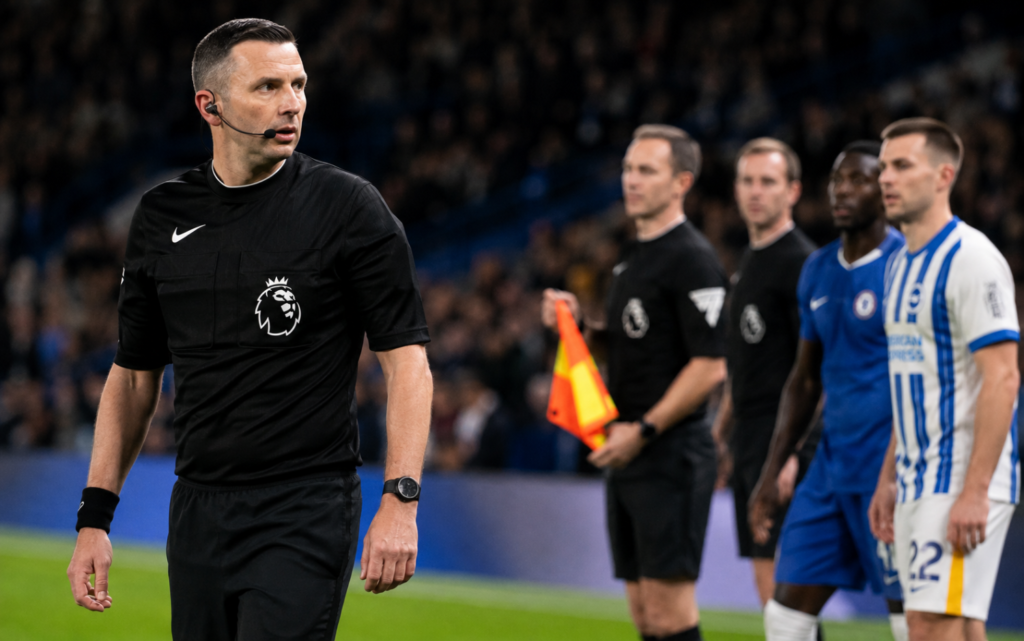
Premier League referee Michael Oliver and his officiating team were forced to complete the second half of Chelsea’s 4-3 win over Brighton without their usual radio communication system after technical problems at Stamford Bridge.
Oliver returned to the pitch after half-time without his communications pack, leaving the referee, assistant referees Stuart Burt and James Mainwaring, fourth official Tom Bramall and the VAR team unable to communicate through the standard headset network.
The failure created an unusual situation in the modern Premier League, where officials have relied on radio technology for roughly two decades.
Referees first began experimenting with microphones and earpieces during the 1999-2000 season. More advanced systems became established from 2006-07 and have since become an essential part of match officiating.
Technical interruptions are not unprecedented, with matches occasionally delayed while batteries or communication equipment are repaired. However, abandoning the system entirely for a full half is exceptionally rare.
The problem at Stamford Bridge reportedly involved excessive stadium noise coming through the system. Normally, background sound from supporters is filtered so officials can hear one another clearly, but that process was not working properly.
The communication breakdown also affected VAR procedures. Video assistant referee Andrew Kitchen could no longer speak directly with Oliver, removing one of the normal elements of the review process.
Instead, Kitchen continued conducting checks using a backup arrangement that allowed messages to be delivered to Oliver’s watch. He was also able to maintain radio contact with fourth official Bramall.
Without direct conversations with the referee, VAR decisions had to rely more heavily on Kitchen’s interpretation of the available footage rather than combining the video evidence with Oliver’s description of incidents on the pitch.
Premier League officials now carry an increasing amount of technology during matches, ranging from communication equipment to vanishing spray and, in some cases, RefCam devices.
For one unusual half at Stamford Bridge, however, Oliver and his colleagues had to officiate much more like referees from an earlier era, relying primarily on positioning, visual signals and traditional teamwork.