
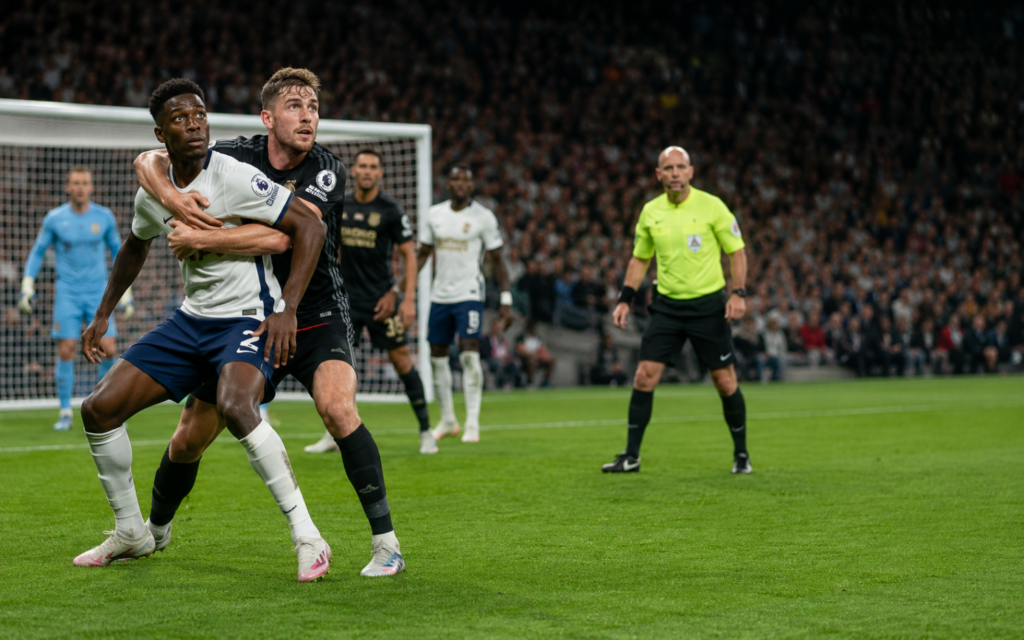
Premier League referees have been instructed to take a firmer approach to holding, wrestling and other off-the-ball offences inside the penalty area when the new season begins.
The laws themselves have not been rewritten, but officials across the Premier League, English Football League and Women’s Super League are being asked to punish clear non-footballing actions more consistently.
The change follows growing concern over the amount of grappling at corners and free-kicks last season, when defenders and attackers were regularly seen pulling, blocking and wrestling opponents during set-pieces.
Referees will now be encouraged to intervene more quickly when holding has an obvious effect on an opponent, particularly when a player is prevented from reaching or challenging for the ball.
More attention on off-ball offences
One of the biggest problems identified during last season’s review involved incidents away from the immediate action.
Of the 20 situations judged to have been missed VAR interventions, five involved penalties that should have been awarded after players were pulled or wrestled to the ground off the ball.
Officials have therefore been told to look more closely at actions where a player ignores the ball completely and concentrates only on stopping an opponent.
Examples include using both arms to hold another player, prolonged pulling of shirts or bodies, and attempts to restrict movement without making any genuine effort to challenge for possession.
Defenders who turn away from an incoming set-piece solely to block an attacker are also more likely to be penalised.
Premier League refereeing chief Howard Webb wants officials to rely less on repeated warnings and act when they identify a clear offence.
The intention is for any eventual decline in penalties to come because players have adapted their behaviour, rather than because referees have gradually relaxed the standard.
Physical contact will remain part of the game, however. Minor collisions and routine challenges will not automatically lead to fouls, while referees will continue to apply a relatively high threshold.
Goalkeepers will also not receive automatic protection from every piece of contact. Officials are expected to distinguish between an ordinary collision and an action that genuinely restricts a goalkeeper’s ability to play the ball.
Clubs shown examples of new approach
Pro Ref, the organisation responsible for elite refereeing in England, has been visiting clubs during pre-season to explain how the updated interpretation will work.
Players and coaches have been shown video examples from last season, including incidents that were not penalised at the time but would now be expected to result in spot-kicks.
One involved Brentford’s Keane Lewis-Potter and West Ham midfielder Tomas Soucek, while another featured Sunderland’s Luke O’Nien and Leeds defender Pascal Struijk.
Both were identified as examples of holding where the offender was primarily concerned with stopping an opponent rather than playing the ball.
Other situations remain less straightforward.
A penalty awarded to Crystal Palace after Marc Guehi was brought down by Bournemouth defender Bafode Diakite illustrated how opinions can still differ even among professional players.
Pro Ref’s view is that such borderline incidents can reasonably be given by an on-field referee without necessarily meeting the threshold for VAR to overturn the original decision.
That distinction will remain important as officials try to combine stronger on-field decision-making with a limited role for video review.
Referees using tactical preparation
Officials will also continue to receive detailed information before matches about how teams operate.
Analysts study tactical patterns, including set-piece routines, to help referees position themselves where potential offences are most likely to occur.
The preparation is not designed to pre-judge individual players or label anyone as likely to commit a specific offence. Instead, the aim is to improve sightlines and awareness during situations where several players may be competing for space at once.
That preparation could become particularly important given how influential set-pieces have become in English football.
Premier League clubs scored 269 goals from set-pieces last season when penalties and direct free-kicks were excluded.
Those goals represented a record 25.7% of the league’s total output, a higher proportion than in any of Europe’s other major domestic competitions.
Serie A was the closest at 22.3%, while the World Cup recorded a much lower figure of 17.5%.
Set-piece specialists could feel the impact
Arsenal led the Premier League with 25 set-piece goals last season and also had the strongest defensive record in the same area, conceding only seven.
Manchester United were next with 21 goals from set plays, while Tottenham scored 19 despite struggling overall.
At the opposite end, Liverpool conceded a league-high 19 set-piece goals. Chelsea and Newcastle both allowed 17.
A stricter interpretation could therefore alter the balance for teams that rely heavily on physical movement and blocking around corners and free-kicks.
Refereeing officials believe that consistent penalties will eventually force teams to change their methods, reducing the amount of illegal contact without removing legitimate physical competition.
The challenge will be maintaining that standard across the entire season.
Previous refereeing initiatives have sometimes been enforced aggressively in the opening weeks before becoming less visible as the campaign progresses.
This time, the league’s officials will need to show that the tougher approach is more than an early-season experiment and that sustained enforcement can reduce the grappling that increasingly accompanies Premier League set-pieces.