
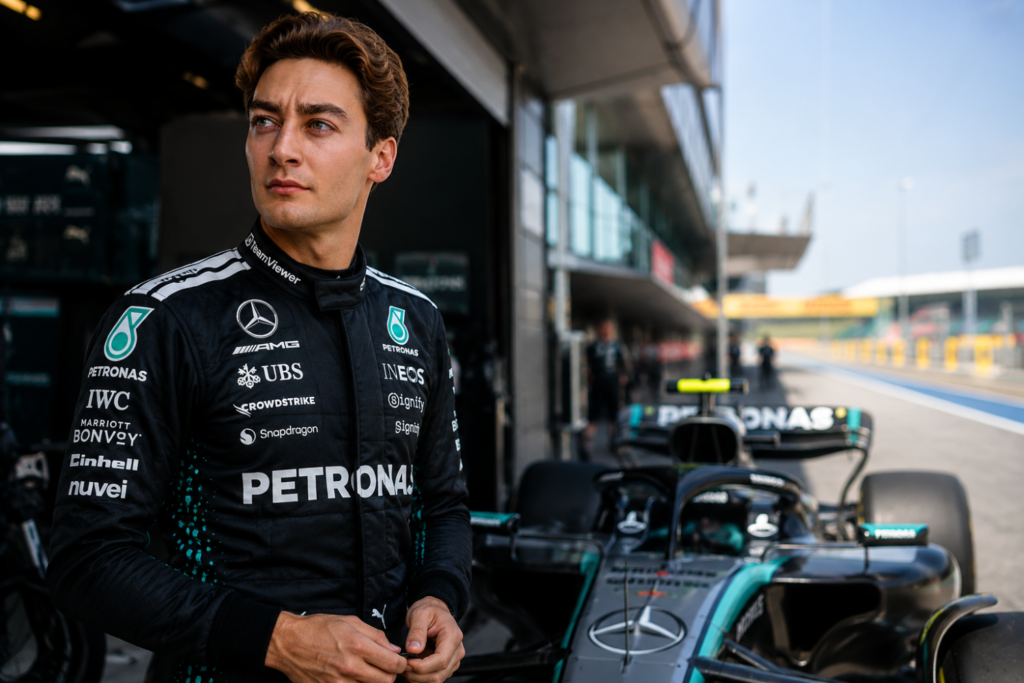
George Russell says this Formula 1 season has demanded more resilience than any other in his career as he works to revive his championship challenge after another frustrating weekend in Belgium.
The Mercedes driver arrives at the Hungarian Grand Prix 50 points behind team-mate Kimi Antonelli, whose victory at Spa-Francorchamps marked his sixth win in the opening 10 races of the season. Russell’s title hopes took another hit after retiring on the opening lap following a collision with Ferrari’s Lewis Hamilton.
Despite the growing gap in the standings, Russell insists he remains confident in both himself and the Mercedes team.
“I definitely feel this is the most resilient I’ve ever been,” Russell said. “I still believe in myself and the team, even when everything looks against us. Earlier this season I’ve managed to bounce back from difficult weekends and deliver strong results.”
Before Belgium, Russell had significantly reduced his championship deficit by scoring consistently in Spain, Austria and Great Britain, cutting the gap from 66 points to 25. He believes those performances showed clear progress, even if Spa interrupted his momentum.
Mercedes has since identified the technical problem that compromised Russell’s weekend in Belgium. Engineers traced the issue to a deeply hidden calibration and software fault within the hybrid power unit, which limited electrical energy deployment during the final section of each lap.
According to Russell, the fault was extremely difficult to detect because of the complexity of modern Formula 1 power units.
He explained that circuits such as Spa and Silverstone exposed the issue more clearly due to their layouts and confirmed he was relieved the team had finally found the cause.
The electrical deployment problem cost Russell approximately half of the five-tenths of a second he lost to Antonelli during qualifying. It also played a decisive role in the opening-lap incident during Sunday’s race.
While both Mercedes drivers briefly suffered the same loss of electrical power exiting the first corner, Antonelli regained his system after lifting through Eau Rouge while defending against Max Verstappen. Russell, who took the famous corner flat out, remained without full deployment, leaving him vulnerable to Hamilton, who made contact with him at the following chicane and ended his race.
Russell admitted the search for answers had also distracted him from improving other aspects of his driving. After making successful adjustments to his technique following Monaco, he secured pole positions in Austria and Britain and converted the Austrian race into a victory.
However, believing the performance loss was partly linked to his driving style, he spent valuable time trying to adapt further before Mercedes eventually confirmed the issue was entirely technical.
He described that discovery as an important lesson, saying it validated that his driving approach was not responsible for the problems experienced at Spa.
Looking ahead to Hungary, the characteristics of the Hungaroring differ significantly from Spa and Silverstone, raising expectations that Ferrari could be competitive thanks to the circuit’s emphasis on slow-speed cornering.
However, both Ferrari drivers played down those predictions despite the team’s recent success.
Lewis Hamilton said Mercedes remained the benchmark, noting they have been fast at virtually every circuit this season, including Monaco, and warned they could once again be the team to beat in Budapest.
McLaren will also introduce a significant upgrade package this weekend in an effort to regain competitiveness. Nevertheless, reigning world champion Lando Norris urged caution, saying previous upgrades had not always delivered the expected gains.
Norris said the team hopes the latest developments will solve some of its current weaknesses but stressed McLaren would wait until running begins before judging their true impact.