
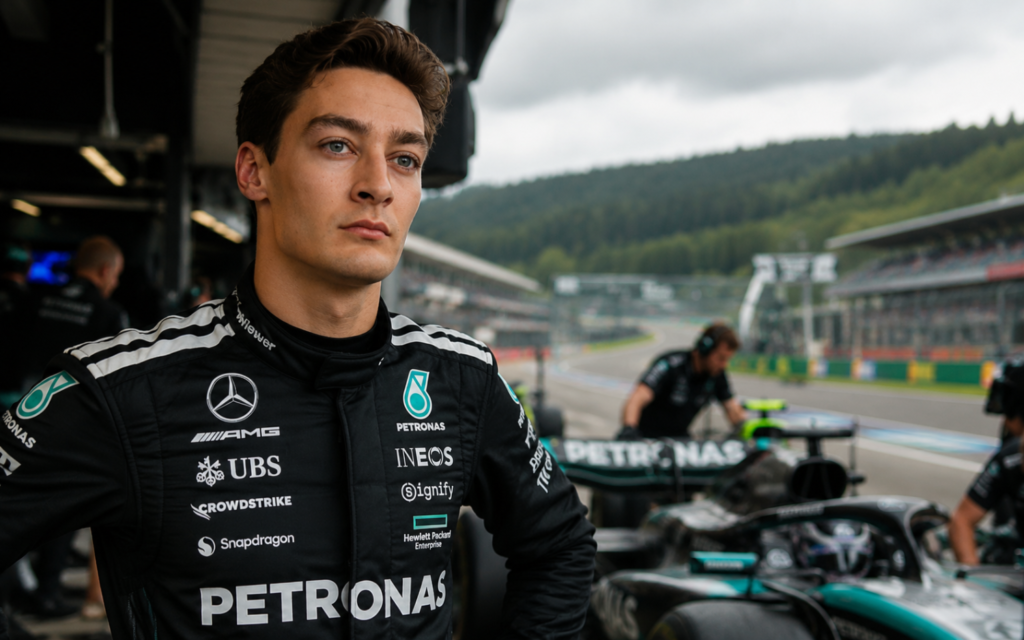
George Russell says he has become “numb” to the setbacks that continue to derail his Formula 1 title challenge after another Mercedes issue contributed to a difficult Belgian Grand Prix and allowed team-mate Kimi Antonelli to dramatically extend his championship advantage.
Russell’s race at Spa-Francorchamps ended on the opening lap after contact with Ferrari’s Lewis Hamilton, who was later penalised for causing the collision. Combined with Antonelli’s sixth victory in the opening 10 races of the season, the result saw the Italian double his lead in the drivers’ standings in a single afternoon.
The Briton admitted he has grown accustomed to misfortune after a season filled with technical problems and ill-timed incidents. Earlier setbacks included qualifying troubles in China, a safety car costing him in Japan, retiring from the lead in Canada and the unresolved Monaco pit-lane speeding controversy. After Silverstone, Russell believed those problems had finally balanced out across the two Mercedes cars, making his 25-point deficit a fair reflection of the season. Spa quickly changed that outlook.
Russell explained that his race unravelled almost immediately because the car’s battery system failed to recharge properly through the opening corner. The resulting lack of electrical energy left him with reduced engine performance heading towards Eau Rouge, where he was unable to defend against faster cars approaching from behind.
According to Russell, he exited the first corner with his battery already heavily depleted before it dropped to zero by the time he reached the famous uphill section. Without the expected power boost, he was rapidly overtaken by several rivals and believes he should never have been exposed to that situation.
While acknowledging that the collision with Hamilton was largely a racing incident and not an intentional move by the Ferrari driver, Russell insisted his biggest frustration was that the technical issue had placed him in such a vulnerable position after making an excellent start.
The engine concerns had already complicated Russell’s weekend before the race. Mercedes initially believed his sizeable pace deficit to Antonelli during Friday practice was caused by differences in driving style, with additional steering corrections costing him momentum and draining battery energy before Spa’s long flat-out final sector.
Although Russell significantly reduced that deficit through qualifying, engineers later identified an unexplained power anomaly that remained. Mercedes-powered McLaren also experienced a similar issue, with Oscar Piastri affected compared with Lando Norris. Sunday’s deployment problem, however, was unrelated and represented an entirely different fault.
Mercedes team principal Toto Wolff confirmed the team had identified an energy deployment issue that affected Russell throughout the weekend and estimated it accounted for at least half of the performance gap to Antonelli in qualifying. He also revealed that all Mercedes-powered cars experienced reduced energy deployment exiting Turn One during the race, although Russell was impacted more severely than his team-mate.
Wolff said Mercedes would work to restore Russell’s confidence before next weekend’s Hungarian Grand Prix, the final event before Formula 1’s summer break. He stressed that both driver and team share responsibility for disappointing results and insisted Mercedes remains fully behind Russell despite the repeated setbacks.
While Russell endured another frustrating weekend, Antonelli once again demonstrated why he has become the championship favourite. The Italian looked comfortable throughout the event, consistently showed stronger pace than his team-mate and remained composed even after an unfortunate virtual safety car briefly handed Ferrari’s Charles Leclerc the race lead.
Antonelli also suffered the same battery deployment problem at the start, allowing Max Verstappen to surge past before Eau Rouge. Initially confused by the sudden loss of performance, Antonelli quickly recovered and fought back before eventually regaining control of the race.
The 19-year-old explained that managing the hybrid power systems has become increasingly complex this season because of the balance between electrical and combustion power. He noted that drivers can sometimes trigger unexpected behaviour through changes in driving style, particularly at energy-intensive circuits such as Spa, while praising Mercedes engineers for managing an extremely complicated system.
A second virtual safety car proved perfectly timed for Ferrari, allowing Leclerc to complete his pit stop while losing less time and emerge ahead of Antonelli. Nevertheless, the Mercedes driver steadily closed the gap before overtaking the Ferrari and securing another convincing victory.
Although Antonelli controlled the race, rivals sensed Mercedes may not have enjoyed quite the pace advantage many had expected. McLaren’s Lando Norris said his team had been pleasantly surprised to remain closer to Mercedes than anticipated and expressed optimism that upcoming upgrades for the Hungarian Grand Prix could further close the gap in the battle at the front.