
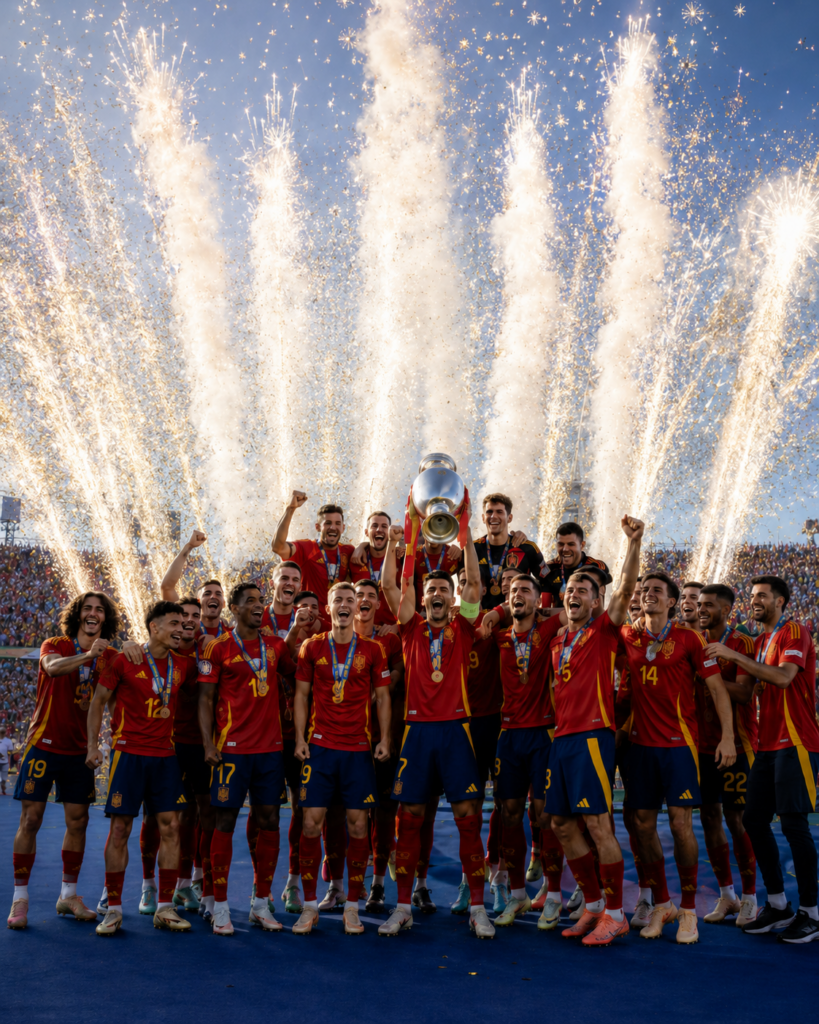
Spain have won the 2026 FIFA World Cup after beating Argentina 1-0 in extra time at New York New Jersey Stadium. Ferran Torres scored the only goal in the 106th minute, finishing a move created by two other substitutes, Pedro Porro and Nico Williams.
The score suggests a close final. The match itself was not balanced. Spain controlled the ball, pressed Argentina into their own half and finished with 20 attempts against one. Emiliano Martínez kept the defending champions alive for more than 100 minutes, but Argentina’s resistance finally broke after Enzo Fernández was sent off late in regulation time.
Spain took control immediately
Lamine Yamal produced the first serious moment after only five minutes. He found space on the right, moved inside and forced Martínez into an early save. It established the pattern for the rest of the match: Spain attacking with width and Argentina defending close to their own penalty area.
Spain had 65 percent of possession in the first half. Argentina did not attempt a single shot and barely entered the Spanish box. Lionel Messi spent long periods away from the ball, while Julián Álvarez was isolated between Spain’s centre-backs.
Mikel Oyarzabal had Spain’s clearest first-half opportunity in the 39th minute. He received the ball inside the area and shot early, but his effort was too close to Martínez. Marc Cucurella also tried his luck from distance shortly before the break, sending a low strike narrowly wide.
Argentina’s first personnel change came before half-time. Lisandro Martínez, who had already been booked for bringing down Oyarzabal, suffered an injury and was replaced by Nicolás Otamendi. Leandro Paredes then replaced Nico González during the interval as Argentina attempted to add another midfielder and slow Spain’s circulation.
Martínez kept Argentina in the match
Spain’s pressure increased after the break. Álex Baena collected a loose pass near the Argentine area but produced a tame finish. Dani Olmo, Ferran Torres, Pedri and Pau Cubarsí all tested or threatened Martínez as Spain began to accumulate corners and shots.
Luis de la Fuente changed the attack in the 62nd minute, replacing Oyarzabal and Fabián Ruiz with Ferran Torres and Pedri. Nico Williams and Mikel Merino followed in the 75th minute. Those substitutions eventually decided the final.
Argentina concentrated almost entirely on defending. Nahuel Molina replaced Gonzalo Montiel, while Facundo Medina and Giuliano Simeone came on for Cristian Romero and Rodrigo De Paul. Messi remained on the pitch, but Spain’s counter-press prevented Argentina from supplying him in dangerous positions.
Martínez saved repeatedly, including efforts from Olmo, Torres, Pedri, Cubarsí and Laporte. By the end of the match he had made 11 saves, one of the highest totals produced by a goalkeeper in a World Cup final.
Enzo Fernández’s red card changed the final
Enzo Fernández received his first yellow card in the 82nd minute after an incident involving Cucurella. In stoppage time, with Argentina already under sustained pressure, he arrived late against Cubarsí and received a second booking.
The dismissal left Argentina with ten players just before extra time. It was avoidable and especially costly because Argentina had survived the most difficult part of the match and were approaching a penalty shootout, a scenario that would have suited both Martínez and their recent tournament history.
Spain nearly won the final before the end of regulation. Nico Williams forced another save from Martínez, while Yamal’s free kick in the 98th minute was pushed around the post. After 90 minutes, Spain had recorded 15 shots and 66 percent possession. Argentina still had no attempt at goal.
Nico Williams scored, but the goal was disallowed
Spain thought they had taken the lead in the 96th minute. Martínez failed to hold a cross and Williams placed the loose ball into the net, only for the referee to stop play for a foul by Merino on Otamendi.
The replay showed Merino stepping on Otamendi’s foot during the challenge. The contact was not heavy, but the decision remained unchanged after the review and the goal was disallowed.
Merino went close again in the 103rd minute, meeting Williams’ curling delivery with a stretching header that passed just wide of the far post. Argentina responded by removing Álvarez and adding Marcos Senesi, effectively forming a five-man defensive line around Messi.
Torres scores the goal that wins the World Cup
The breakthrough arrived 37 seconds after the beginning of the second period of extra time.
Pedro Porro delivered a deep cross from the right. Williams reached it at the far side and headed the ball back into the centre, where Torres arrived unmarked. The substitute struck first time with his left foot and drove the ball into the roof of the net.
It was a goal created entirely by players who had not started the final. Porro supplied the cross, Williams provided the assist and Torres finished the move. De la Fuente’s substitutions had given Spain fresh width and movement at the exact moment Argentina’s ten men were beginning to tire.
Argentina finally registered their first shot late in extra time when Messi tried to score from distance. His effort struck Merino and went wide. It carried an expected-goals value of approximately 0.04 and did not require a save from Unai Simón.
That was the full extent of Argentina’s attacking production. They completed 120 minutes of a World Cup final without placing a shot on target.
Final match statistics
| Statistic | Spain | Argentina |
|---|---|---|
| Final score | 1 | 0 |
| Possession | 67% | 33% |
| Total shots | 20 | 1 |
| Shots on target | 12 | 0 |
| Expected goals | 1.94 | 0.04 |
| Big chances | 4 | 0 |
| Corners | 9 | 2 |
| Offsides | 4 | 1 |
| Total passes | 835 | 422 |
| Accurate passes | 755 | 327 |
| Pass accuracy | 90% | 78% |
| Fouls | 18 | 24 |
| Goalkeeper saves | 0 | 11 |
| Substitutions used | 6 | 6 |
| Player yellow cards | 0 | 4 |
| Red cards | 0 | 1 |
| Disallowed goals | 1 | 0 |
Spain’s second world title
Spain have now won the World Cup twice, adding the 2026 trophy to their first title from 2010. The winning goal arrived ten minutes earlier than Andrés Iniesta’s famous strike against the Netherlands, but the resemblance was clear: another tense final, another extra-time winner and another clean sheet.
Argentina entered the match with the tournament’s most productive attack. Spain reduced that attack to one deflected attempt in 120 minutes. Messi could not dictate the final, Álvarez received almost no service and Martínez’s performance merely delayed a result that Spain’s control had made increasingly likely.
Yamal did not score, but the 19-year-old was Spain’s main threat from the opening minutes and forced Martínez into several saves. Williams had one goal disallowed before creating the winner. Torres entered from the bench and scored the goal that made Spain world champions.
The trophy was won by the full squad, not by one established star. That was the defining feature of Spain’s tournament, and it remained true until the final touch of the final.