
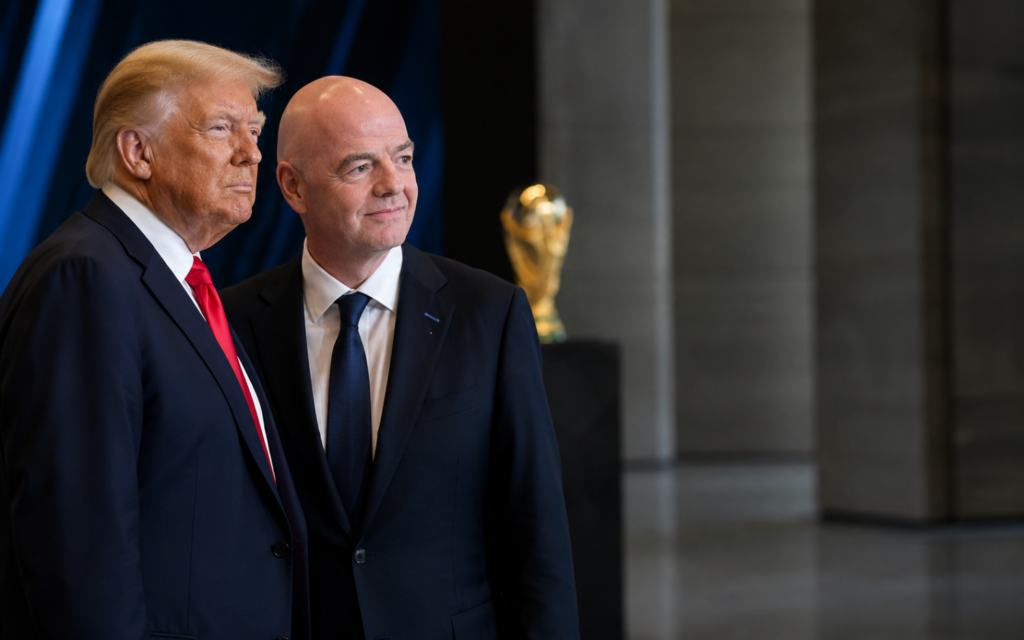
US President Donald Trump has publicly backed FIFA president Gianni Infantino as the football executive faces growing calls to step down following the collapse of a controversial plan to bring private investment into FIFA’s commercial operations.
Trump warned against removing Infantino and credited him with overseeing the commercially successful 2026 World Cup, which was staged across the United States, Canada and Mexico and ended with Spain defeating Argentina in the final. His intervention marks his strongest defence of the FIFA president since details of the FIFA Forward Enterprise project emerged in late July.
The abandoned FFE proposal would have created a separate company responsible for commercial activities linked to FIFA tournaments, including media, sponsorship and ticketing rights. FIFA planned to allow outside investors to acquire a minority interest of up to 21%, with the new business reportedly valued at around $20bn.
FIFA initially presented the project as a way of generating additional money for football development, with Thrive Eternal expected to lead the investor group. The firm is associated with US investor Joshua Kushner, whose brother Jared Kushner is Trump’s son-in-law. FIFA officially outlined Thrive Eternal’s expected involvement when announcing the project on 28 July.
The proposal quickly triggered opposition from major football bodies and was subsequently abandoned. UEFA, Concacaf and the Asian Football Confederation have since intensified pressure on FIFA’s leadership, jointly accusing the organisation of serious governance failures and arguing that the process surrounding FFE damaged trust between FIFA and its member bodies.
Their open letter stopped short of directly demanding Infantino’s resignation by name, but the dispute has significantly increased scrutiny of his position. The three confederations have also sought an independent external investigation into how the proposal was developed.
UEFA has separately warned that legal action remains possible over the failed project. European federations have also discussed the possibility of boycotting FIFA competitions, while early discussions involving UEFA, Concacaf and the AFC have reportedly considered what alternative competitions could look like if the wider dispute cannot be resolved.
The confrontation has developed into one of the most serious governance challenges of Infantino’s presidency. FIFA has responded by claiming that there is a coordinated attempt to weaken both the organisation and its president, while support for Infantino remains stronger among some other regional confederations.
Trump’s intervention adds a significant political dimension to the dispute. Infantino has developed a close relationship with the US president and presented Trump with the inaugural FIFA Peace Prize in December 2025.
When the FFE controversy first escalated at the end of July, Trump said he had not discussed the investment proposal with Infantino. His latest comments, however, make clear that he believes FIFA should keep its current president despite the growing pressure from several of world football’s most influential regional bodies.
With criticism spreading and FIFA’s leadership facing demands for greater accountability, the fallout from the abandoned investment plan is now increasingly focused on Infantino’s future at the top of world football.