
FIFA’s handling of political influence and contentious disciplinary decisions during the 2026 World Cup has damaged confidence in the tournament, according to sports integrity expert Declan Hill.
Hill, an associate professor of investigations at the University of New Haven, said the governing body had entered a “gray area” in which perceptions of interference became almost as damaging as proven wrongdoing.
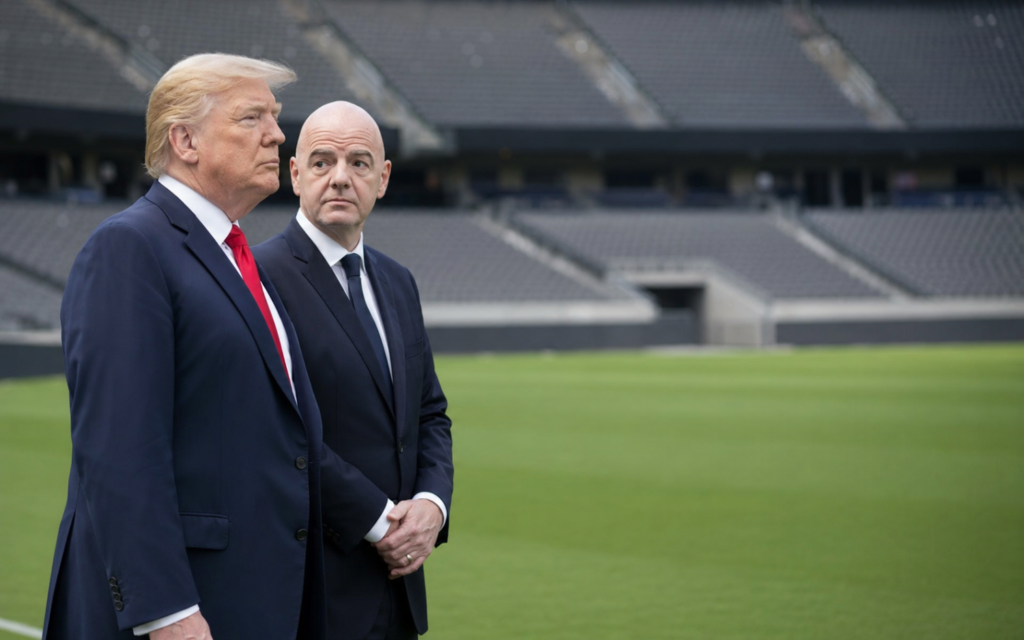
His concerns centred on the relationship between US President Donald Trump and FIFA President Gianni Infantino, particularly the controversy surrounding United States forward Folarin Balogun.
Balogun was sent off against Bosnia and Herzegovina, ordinarily triggering an automatic one-match suspension. However, the ban was overturned after Trump contacted Infantino and publicly took credit for helping secure a review of the decision. Balogun was consequently available for the round-of-16 match against Belgium, which the US lost 4-1.
The intervention prompted a significant backlash across European football. UEFA President Aleksander Čeferin reportedly stayed away from the World Cup final in protest, while Norwegian Football Federation President Lise Klaveness announced plans to submit a formal ethics complaint over the episode.
Klaveness argued that allowing a national leader to influence a disciplinary matter created a dangerous precedent and conflicted with FIFA’s commitment to political neutrality. The reversal was especially controversial because Balogun was reportedly the only player among 14 sent off during the tournament whose suspension was rescinded.
Hill stopped short of alleging that matches were manipulated. Instead, he said FIFA had created conditions in which ordinary supporters could reasonably question whether sporting decisions were being made independently.
The controversy added to criticism of inconsistent refereeing, disputed video assistant referee interventions and allegations that certain teams and high-profile players received preferential treatment. Hill said the accumulation of such incidents weakened public trust even without proof of deliberate manipulation.
Those concerns contrasted sharply with the tournament’s commercial and popular success. Spain defeated Argentina 1-0 after extra time in the final, concluding a 104-match competition staged across 16 cities in the United States, Canada and Mexico.
The final attracted a record US audience. Fox’s English-language broadcast averaged approximately 38.9 million viewers, while the combined audience across Fox and Telemundo reached an estimated 66.4 million. Fox also reported that its coverage averaged 7.7 million viewers across the full tournament, more than double its average for the 2022 edition.
Betting activity created another layer of scrutiny. The Group of Copenhagen, a network established under the Council of Europe’s Convention on the Manipulation of Sports Competitions, reportedly issued seven notices involving unusual wagering patterns during the World Cup.
Among the cases examined were markets connected to Balogun’s eligibility, Themba Zwane’s dismissal during South Africa’s opening match against Mexico and betting surrounding Spain’s 4-0 victory over Saudi Arabia.
The group emphasised that irregular betting does not itself prove match-fixing. However, it raised concerns about prediction platforms that permit wagers on a broad range of events, sometimes using anonymous accounts and payment methods that are difficult to trace.
FIFA’s Integrity Task Force reached a different conclusion, saying its monitoring of all 104 matches found no evidence of suspicious betting activity or manipulation. The disagreement illustrated the difficulty of overseeing a global betting market in which a large proportion of wagers are placed through offshore operators.
Before the tournament, the Council of Europe had already identified prediction markets, artificial intelligence and monitoring arrangements for the World Cup as important areas for integrity authorities. Its Group of Copenhagen brought together representatives from 36 countries in May to prepare for those challenges.
Hill said the central issue was not whether corruption would eventually be established, but whether supporters believed FIFA possessed credible and independent systems for investigating it.
The 2026 World Cup delivered packed stadiums, unprecedented American television audiences and a dramatic conclusion. Yet the political controversy surrounding FIFA’s leadership and the questions raised by betting monitors ensured that the tournament’s integrity remained under scrutiny after the final whistle.