
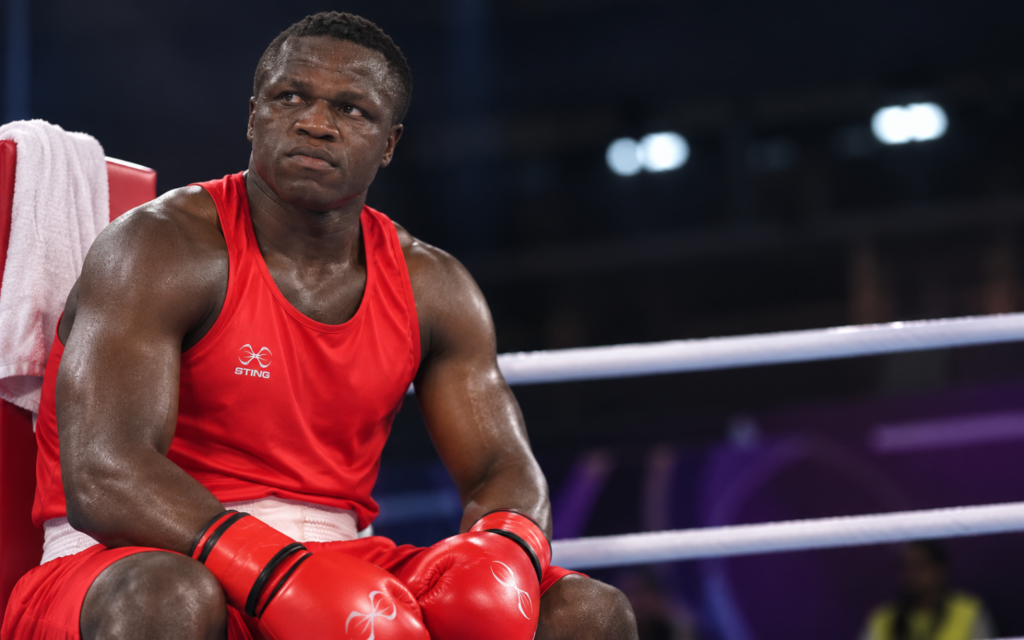
Ugandan super-heavyweight Aziz Abdul has accused officials of racial bias after being disqualified from his Commonwealth Games quarter-final against England’s Damar Thomas, but Commonwealth Sport president Donald Rukare has firmly rejected the allegation.
Abdul was disqualified after officials ruled that he deliberately headbutted Thomas during an exchange in the third round. Before the stoppage, the Ugandan had already received warnings in each of the opening two rounds and was behind on every judge’s scorecard.
Following the contest, Abdul argued that the officiating favoured the English boxer because the event was taking place on home soil. He claimed punches he believed had landed cleanly were ignored while points were deducted from him for fouls, insisting he had been treated unfairly because he was a Black African competing against a local athlete. During his post-fight remarks, Abdul also referred to Thomas using a racial slur.
Rukare dismissed suggestions that race had influenced the outcome.
“We at Commonwealth Sport believe every athlete is treated fairly and in a non-discriminatory manner,” he said, adding that the disqualification was strictly a field-of-play decision and describing Abdul’s comments as being made in the heat of the moment.
Abdul maintained that any clash of heads was accidental, claiming Thomas had struck him with an elbow beforehand and insisting he had no intention of headbutting his opponent. He argued he entered the contest believing he would need a knockout to secure victory.
The result ended Abdul’s hopes of becoming Uganda’s first Commonwealth boxing medallist since the 1990 Games in Auckland. Thomas, meanwhile, advanced to the semi-finals, guaranteeing himself at least a bronze medal.
The English boxer admitted the victory was not achieved in the way he would have preferred but said his focus had already shifted to his next bout.
Rukare also suggested Abdul’s conduct could be reviewed by the Ugandan delegation, noting that the team has its own disciplinary procedures and code of conduct that would determine whether further action is required.
Abdul attracted attention before the tournament by declaring his ambition to become the new “King of Scotland” — a reference to the self-styled title adopted by his grandfather, former Ugandan dictator Idi Amin, in 1976.
Amin seized power in a military coup in 1971 and presided over one of Africa’s most brutal regimes, with an estimated 500,000 people killed during his rule. Nicknamed the “Butcher of Uganda,” he also developed an unusual fascination with Scotland after serving in the King’s African Rifles, often wearing a kilt, playing the bagpipes and proclaiming himself “King of Scotland.” His eccentric image later inspired the Oscar-winning film The Last King of Scotland, starring Forest Whitaker and James McAvoy.
Although Abdul never met his grandfather, he has previously described himself as being inspired by him, though he has never clearly explained whether he was referring to Amin’s boxing background or another aspect of his legacy. When asked whether he was proud of the family connection, Abdul declined to answer directly but acknowledged that he is frequently associated with his grandfather’s notorious reputation.