
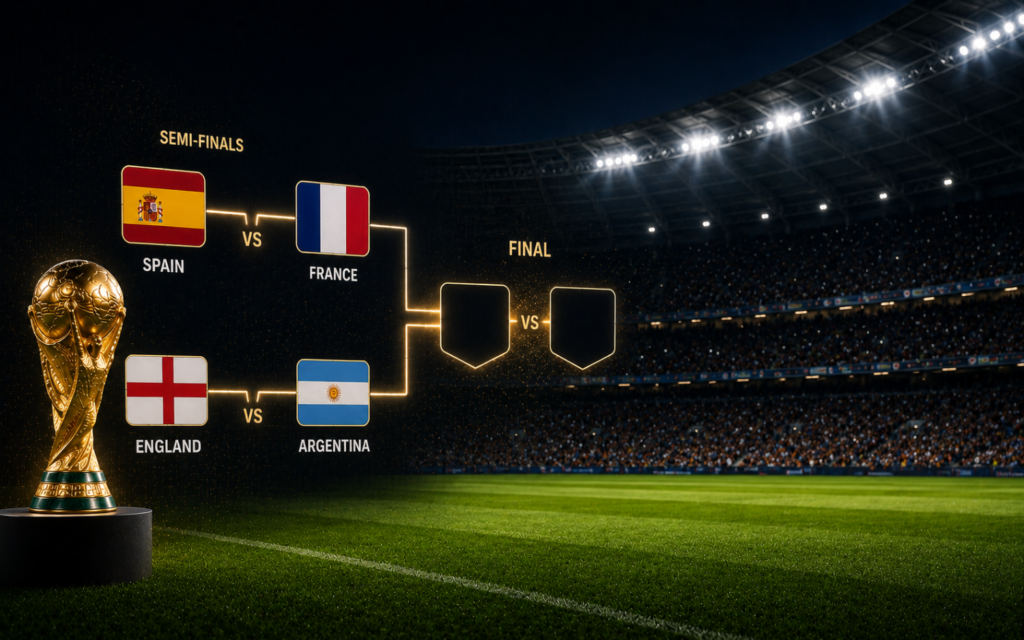
Fifa’s revised draw system for the expanded 2026 World Cup has produced the outcome it was designed to achieve, with the four highest-ranked nations in the world all reaching the semi-finals for the first time in the tournament’s history.
Current world number one Spain will face third-ranked France on Tuesday, while second-ranked Argentina take on fourth-ranked England a day later. The winners will advance to the World Cup final.
The change was introduced specifically for the 48-team tournament, which features an additional knockout round compared with previous editions. To reduce the chance of the highest-ranked teams eliminating each other too early, Fifa placed the top four nations into separate sections of the knockout bracket before the competition began.
That arrangement meant Spain and Argentina could not meet until the final, while England and France were placed on opposite sides of the draw, each set on a potential semi-final collision with either Spain or Argentina.
Fifa said the updated system was intended to preserve “competitive balance” by creating two distinct routes to the semi-finals for the leading seeds.
The plan depended on all four nations finishing first in their respective groups, something each successfully achieved before progressing through the knockout stages.
The expanded format created a new challenge that did not exist in the previous 32-team World Cup. With an extra knockout round, group winners could now face one another much earlier in the tournament, increasing the likelihood of heavyweight clashes before the semi-finals.
That scenario played out several times in this year’s round of 16, including matches between the United States and Belgium, England and Mexico, and Switzerland against Colombia.
In previous World Cups, early meetings between the world’s highest-ranked sides were relatively uncommon. The last time two of the top four nations met before the semi-finals was in 2010, when the Netherlands defeated Brazil in the quarter-finals.
Since the introduction of the FIFA World Ranking system in 1994, no World Cup had featured all four top-ranked teams reaching the last four. Several highly ranked nations, including Belgium in 2022, Germany in 2018, Spain in 2014, Italy in 2010 and France in 2002, failed to even advance beyond the group stage despite entering among the world’s top four.
Fifa also applied a similar seeding principle at last year’s Club World Cup, although only one of the top four seeds, Real Madrid, progressed as far as the semi-finals.
This time, however, the governing body’s revised draw structure has produced exactly the blockbuster semi-final line-up it was hoping to see.