
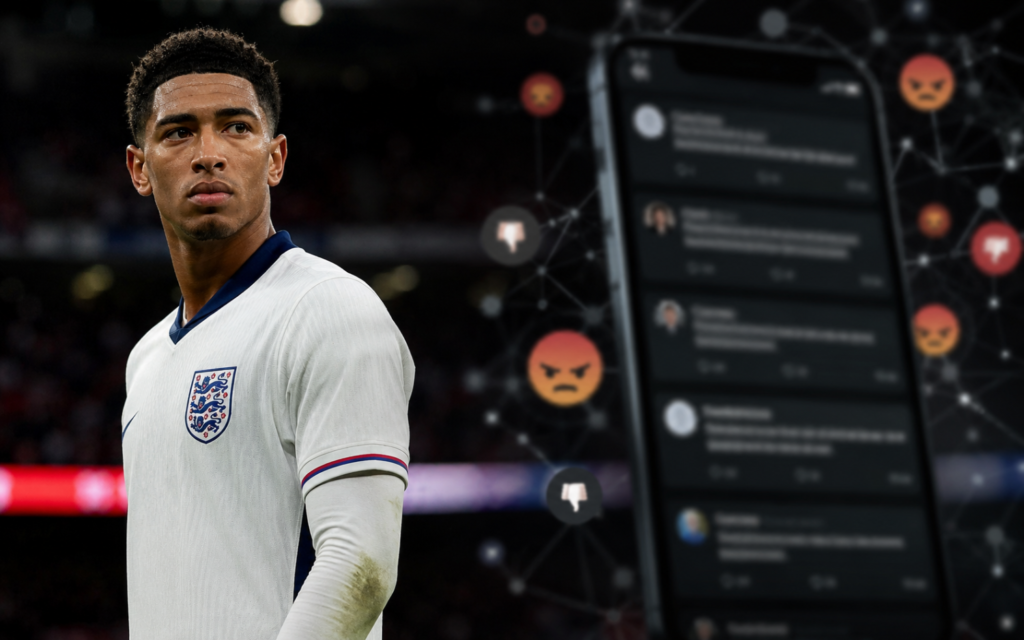
Racist abuse targeting England players during the 2026 World Cup was significantly amplified by X’s recommendation systems, according to research by campaign group Hope Not Hate.
The organisation reviewed more than 300,000 posts published on the platform during the tournament and identified over 5,500 posts containing explicit racist abuse directed at England footballers.
Its analysis concluded that abusive material was not confined to isolated accounts or small online communities. Instead, X’s recommendation system helped expose the content to much wider audiences by promoting posts that generated high levels of reaction and engagement.
Hope Not Hate said material provoking anger or outrage can attract replies, reposts and prolonged viewing, giving platforms an incentive to keep highly divisive conversations visible. The group argues that this creates a system in which abusive content can spread far beyond the accounts that originally publish it.
Bellingham Among Most Targeted England Players
Jude Bellingham received the largest overall volume of racist abuse identified in the study.
Bukayo Saka and Kobbie Mainoo recorded the highest proportion of racist material relative to the total number of posts mentioning them, while Djed Spence was also targeted with a separate wave of anti-Muslim hostility. Spence converted to Islam in recent years.
Researchers also studied replies underneath individual high-profile posts to understand how quickly abuse accumulated and how recommendation systems could further increase its visibility.
The Football Association said players should be able to compete without being subjected to discriminatory and distressing material online and called on technology companies to take stronger action to improve safety across their services.
Hope Not Hate said existing responses to online racism remain too focused on action taken after abusive material has already reached its target.
Blocking users, reporting posts and suspending accounts can limit individual offenders, but the organisation argues those measures do little to address the systems that distribute inflammatory material to much larger audiences.
According to the research, relatively small numbers of original posts and accounts can generate large waves of hostile replies once the content begins receiving increased exposure.
Calls for Algorithm Changes and Stronger Regulation
Hope Not Hate believes social media companies could reduce abuse by changing how recommendation systems respond when posts begin attracting unusually large quantities of racist or hateful replies.
One proposed measure is to automatically reduce the visibility of posts experiencing rapid increases in abusive engagement rather than continuing to recommend them to additional users.
Ahead of the new Premier League season, the organisation also urged UK communications regulator Ofcom to make greater use of powers available through the Online Safety Act.
It wants major sporting competitions to be treated as periods of heightened online risk because abuse against players can become more predictable during major matches and international tournaments.
Under the proposed approach, platforms would be expected to introduce stronger preventative safeguards during those periods, identify escalating abuse earlier and adjust recommendation systems before harmful content becomes widely distributed.
Ofcom said it is continuing to pressure technology companies to improve user safety and will take action when firms fail to meet their obligations. The regulator also pointed to cooperation established with police and football authorities before the World Cup to address online abuse.
More Than 300,000 Posts Examined
Hope Not Hate gathered posts that mentioned England players by name or X username, along with replies directed at player and team accounts. Searches also covered references to the England team and other tournament-related terms, with irrelevant material removed before analysis.
Artificial intelligence tools were then used to classify posts using examples previously labelled by human researchers.
The system identified several categories of racist abuse, as well as far-right narratives and hateful slogans. Researchers manually reviewed samples to test the accuracy of the classifications.
Each post was ultimately recorded as either abusive or non-abusive rather than being ranked according to the intensity or severity of the language.
The findings have increased pressure on social media platforms to address not only the users responsible for racist abuse, but also the recommendation systems that can dramatically expand its reach.