
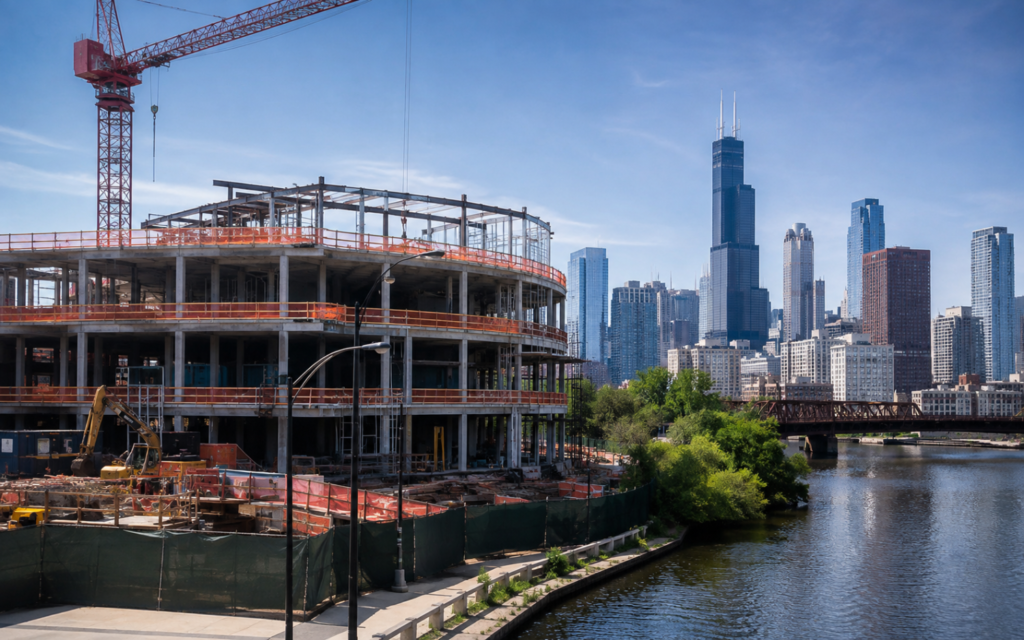
A majority of Chicago City Council members are pressing Bally’s to resume full construction of its $1.7 billion permanent casino resort after the operator slowed work on several non-gaming elements of the development amid a dispute over video gaming terminals.
Twenty-eight alderpersons backed a letter urging Mayor Brandon Johnson to enforce the city’s Host Community Agreement with Bally’s. The intervention follows the company’s decision to reduce the pace of construction on parts of the River West project, including the planned hotel, entertainment venue and some restaurant facilities. Work on the casino itself is continuing, with Bally’s still targeting an early 2027 opening for the permanent gaming property.
Council challenges partial construction plan
The alderpersons argue that Bally’s obligations extend well beyond delivering a functioning casino floor. Under their interpretation of the agreement, completion of the project depends on substantial progress across the hotel, retail, entertainment, exhibition, green space and Riverwalk elements promised as part of the wider development.
The group has warned that it could pursue a public hearing and potentially legal action if the city does not ensure the full project is delivered. Their response increases political pressure on Bally’s only months after the operator celebrated the topping-off of the casino structure, which it described in May as a major step toward opening the resort in spring 2027.
When completed as originally planned, the development is expected to include 3,400 slot machines, 173 table games, a 500-room hotel, 10 food and beverage venues, a 3,000-seat entertainment and event space, 3,300 parking spaces and new public riverfront areas. Bally’s has previously projected approximately 3,000 permanent jobs from the finished complex.
VGT dispute remains at centre of conflict
Bally’s has linked the slowdown to Chicago’s move to legalize video gaming terminals in bars and restaurants. The company maintains that widespread VGT availability could undermine the casino’s economics and conflict with commitments made by the city under the Host Community Agreement.
Chicago authorized video gambling as part of its 2026 spending plan, with the budget relying on an estimated $6.8 million in VGT-related revenue. However, city authorities had not issued the local licenses needed for any terminals to begin operating as of August 10. Six operators had received state approval, while another 294 bars and restaurants had applied for state licenses.
That situation has led some council members to question Bally’s explanation. Aldermen Brendan Reilly and Anthony Beale have suggested financial pressure may be contributing to the construction slowdown because VGTs are not yet operating in Chicago. Bally’s has not said that financial constraints were responsible for its decision.
The operator has previously warned that VGT expansion could reduce Chicago’s annual gambling revenue by approximately $74 million and put as many as 1,050 projected casino jobs at risk. Mayor Johnson has also opposed the expansion, arguing that casino slot revenue is taxed more heavily and could therefore generate greater returns for the city.
Financial questions add to pressure
The dispute comes after several earlier complications surrounding the Chicago project, including financing challenges, revisions to the hotel design and construction delays.
Gambling Insider reported that Bally’s recently amended its broader credit arrangements after securing a conditional waiver of a leverage covenant from lenders in May. During the relevant waiver period, the company is required to maintain at least $325 million in liquidity at the end of the second and third quarters of 2026.
Despite the latest confrontation, Bally’s says it remains committed to completing its Chicago development. For the City Council, however, the central issue is whether the operator will deliver the entire resort originally promised rather than prioritize the casino while postponing the surrounding hotel, hospitality and entertainment components.