
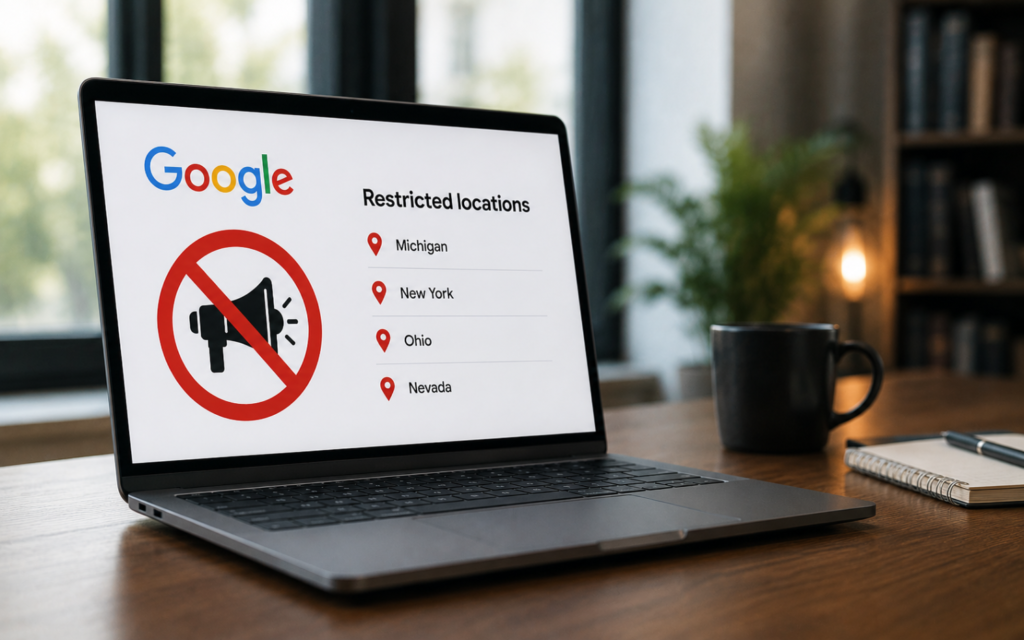
Google has expanded its restrictions on prediction market advertising in the United States, banning ads for prediction market contracts and related products in both Michigan and New York as regulatory pressure on the sector continues to grow.
The policy change took effect on 13 July 2026, making Michigan and New York the latest states where advertisers are no longer permitted to promote prediction market services through Google Ads. The update was published as part of Google’s official Advertising Policies and applies specifically to contracts and related products offered by prediction market platforms.
The move follows Google’s earlier decision to prohibit similar advertising in Ohio, where restrictions came into force in June. Nevada had already been excluded under Google’s prediction market advertising policy, meaning four states are now off-limits for such promotions.
Google first introduced its dedicated prediction market advertising framework earlier this year, allowing certified providers to advertise in eligible US jurisdictions while requiring compliance with local financial, commodity and gaming regulations. However, the company has continued to revise the policy as legal disputes surrounding the industry evolve.
The latest update comes as prediction market operators, including platforms regulated by the US Commodity Futures Trading Commission (CFTC), face increasing scrutiny from state authorities. Several states have challenged the legality of sports event contracts and other prediction market offerings, arguing they fall under state gambling laws despite operators maintaining they are federally regulated financial products.
Google did not provide a detailed explanation for adding Michigan and New York beyond updating its advertising rules. The company stated that prediction market advertising in both states is now prohibited under its US policy, requiring advertisers to stop targeting users in those jurisdictions.
The decision reflects the increasingly fragmented regulatory environment for prediction markets in the US, where platforms continue to face different legal interpretations depending on the state. As enforcement actions and court cases continue, major technology companies are also adjusting their policies to reflect the changing landscape.