
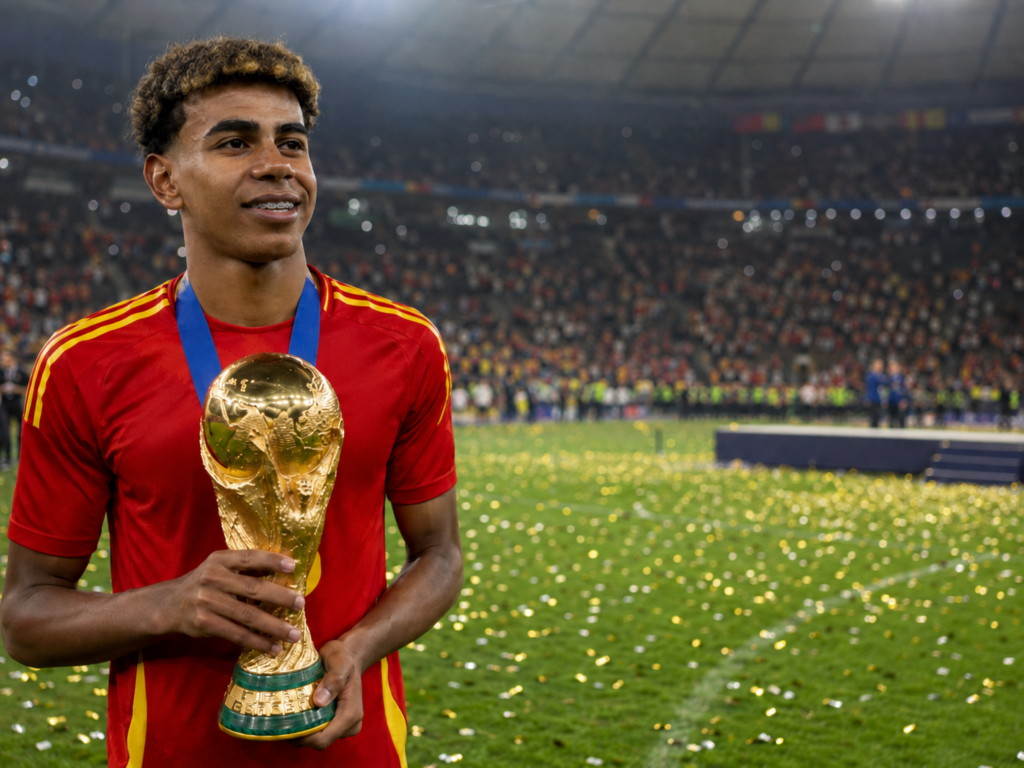
Lamine Yamal became a world champion six days after his 19th birthday. Spain’s 1-0 extra-time victory over Argentina added the World Cup to a career that already included a European Championship, three La Liga titles and several records once thought impossible for a teenager.
The remarkable part is no longer that Yamal has reached the top so early. It is how quickly each historic achievement has started to feel normal.
Growing up in Rocafonda
Yamal was born on 13 July 2007 in Esplugues de Llobregat and grew up in Rocafonda, a working-class neighbourhood in Mataró. The area remains central to his identity. His familiar “304” celebration refers to the final digits of Rocafonda’s postal code and has followed him from youth football to the biggest stadiums in the world.
He started at local club CF La Torreta before joining Barcelona at seven. His progress through La Masia was unusually fast, even by the academy’s standards. Yamal regularly played above his age group and had barely reached the under-19 team when Xavi Hernández began bringing him into first-team training.
Barcelona gave him his senior debut against Real Betis in April 2023. He was 15 years, nine months and 16 days old. He entered late in a 4-0 victory, almost scored and created another chance with a delicate pass over the defence. The appearance was brief, but it showed why the club had accelerated his development instead of following the normal academy timetable.
From academy prospect to Barcelona’s main attacker
Yamal did not remain a symbolic teenage substitute for long. During the 2023/24 season, he made 50 first-team appearances and scored seven goals. By the following campaign, he was no longer being judged as a talented academy graduate. He had become one of Barcelona’s most important attacking players.
Under Hansi Flick, Yamal recorded 18 goals and 21 assists in 2024/25 as Barcelona completed a domestic treble. He became the youngest player in the club’s history to reach 100 appearances and the youngest goalscorer in a Clásico. In 2025/26, he scored 24 times in 45 official matches and helped Barcelona win another league title. By the end of that season, his official first-team record stood at 149 appearances and 49 goals.
Barcelona formalised his new status in July 2025. Yamal signed a contract running until 2031 and inherited the No. 10 shirt. The number carries an unavoidable connection to Lionel Messi, but Yamal’s football has never looked like an attempt to reproduce somebody else’s career. He attacks from the right, slows defenders down, changes direction without warning and creates passing angles that disappear before the opponent can react.
Spain called before he turned 17
Yamal made his senior Spain debut in September 2023 at 16 years and 57 days, becoming the country’s youngest international and youngest goalscorer in the same match.
Euro 2024 turned him from a club phenomenon into a global star. He started Spain’s opening match at 16 years and 338 days, becoming the youngest player to appear at a European Championship. In the semi-final against France, he curled a shot into the top corner and became the competition’s youngest scorer.
He finished the tournament with one goal and four assists, the highest assist total at Euro 2024. He also completed 32 dribbles and created the opening goal for Nico Williams in the final against England. Spain won 2-1, while Yamal was named Young Player of the Tournament one day after turning 17.
The pressure changed after that victory. Yamal was no longer the young player who might decide a major match. Opponents began building their defensive plans around stopping him. Full-backs received constant support, midfielders shifted towards his side and teams accepted leaving space elsewhere if it reduced his opportunities in one-on-one situations.
That attention became part of Spain’s attack. Even when Yamal did not score, his positioning dragged defenders away from the centre and created room for Pedri, Dani Olmo, Nico Williams and Spain’s advancing full-backs.
His first World Cup
Yamal arrived at the 2026 World Cup as a European champion and established Barcelona star, despite still being only 18 when the tournament began. He turned 19 during Spain’s run to the final.
He scored once during the competition and completed 35 dribbles, more than any other player at the tournament. His numbers reflected his role accurately. Spain did not need him to force a shot during every attack. They needed him to receive the ball under pressure, carry it forward and make the defensive structure move.
The final against Argentina brought another layer to his story. Yamal faced Messi, the player whose Barcelona career shaped the expectations now placed on every gifted La Masia attacker. A photograph of Messi holding Yamal as a baby had already become one of football’s strangest coincidences. Nineteen years later, they stood on opposite sides of a World Cup final.
Yamal started on Spain’s right and remained one of their main outlets during a match dominated by possession, patience and defensive control. The decisive moment eventually came from the bench. Pedro Porro crossed, Nico Williams headed the ball back and Ferran Torres scored in the 106th minute.
Spain won 1-0 and became world champions for the second time. Yamal became the third-youngest footballer to play in a World Cup final, behind Pelé and Giuseppe Bergomi. At 19 years and six days, he also became the youngest player to win both the European Championship and the World Cup.
A world champion before his career has properly begun
Yamal already has the international honours that many elite players spend entire careers chasing. He won the European Championship at his first attempt and repeated that achievement at his first World Cup.
There are still areas of his game that will change. He will become physically stronger, learn when to release the ball earlier and face increasingly specialised defensive systems. Barcelona will also have to manage his workload carefully. He has already played a volume of senior football that would be unusual for a player several years older.
What cannot be questioned is the scale of his first three professional seasons. He entered Barcelona’s first team at 15, became a regular at 16, won the European Championship at 17, inherited the No. 10 shirt at 18 and lifted the World Cup at 19.
The records describe how early it all happened. The football explains why.