
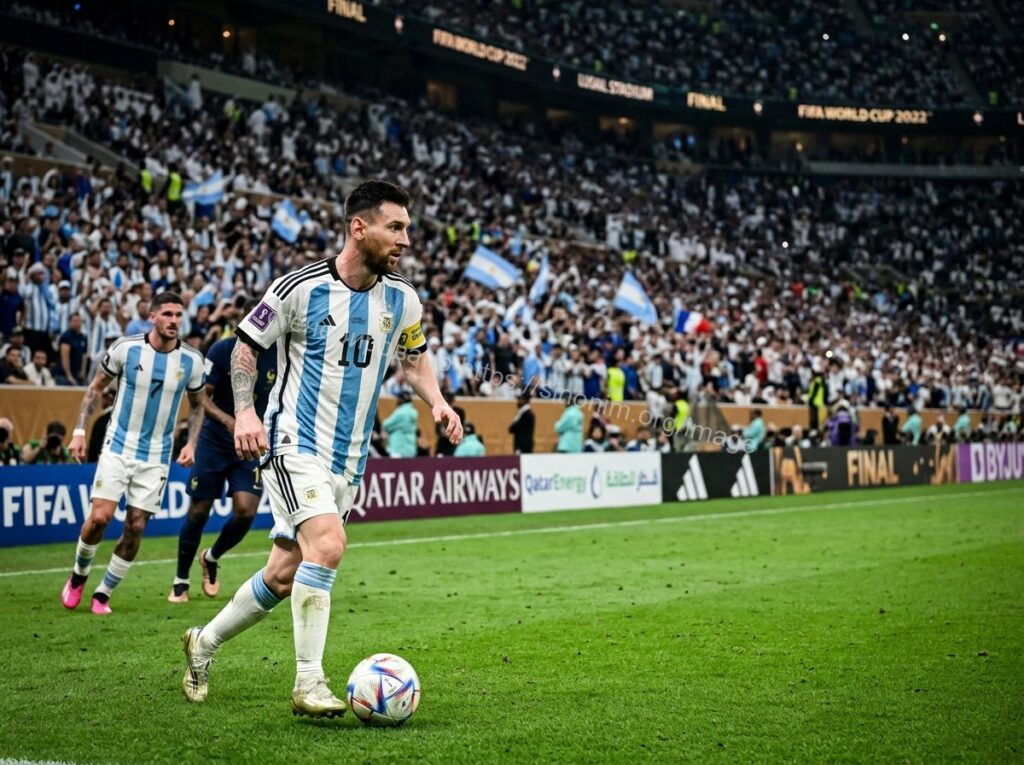
Lionel Messi walked away from his final World Cup match without the trophy.
Spain’s 1-0 extra-time victory over Argentina denied him the perfect ending: a second consecutive world title, achieved at 39, in the same stadium where another generation appeared ready to inherit the game from him.
But Messi’s career stopped needing a perfect ending years ago.
He had already completed the journey from a quiet boy in Rosario to Barcelona’s greatest player, Argentina’s record goalscorer and the captain who finally lifted the World Cup. The defeat in 2026 did not remove anything from that story. It simply provided its final World Cup chapter.
The boy Barcelona brought from Rosario
Messi was born on 24 June 1987 in Rosario, Argentina. He grew up playing football with his brothers and cousins before joining the youth system of Newell’s Old Boys.
His talent was obvious early. So was the physical problem threatening his development.
Messi was diagnosed with a growth hormone deficiency and required treatment that was expensive for his family. Argentine clubs showed interest but no permanent solution emerged. Barcelona eventually offered one.
He moved to Catalonia at 13.
The story has since been reduced to the famous contract supposedly agreed on a paper napkin, but the reality was less romantic. Messi was a small, homesick teenager separated from much of his family, adapting to a new country while trying to prove that Barcelona had not taken an unnecessary risk.
He progressed through La Masia without behaving like a future global superstar. Teammates remembered a quiet boy who spoke little and became entirely different once the ball reached his feet.
Messi made his competitive Barcelona debut against Espanyol in October 2004. He was 17 years, three months and 22 days old. His first senior goal followed in May 2005, when Ronaldinho lifted a pass over the Albacete defence and Messi finished with a delicate lob.
The move looked effortless. Almost everything that followed did too.
Barcelona changed around him
Messi entered a Barcelona team already filled with major players. Ronaldinho was the central figure, Samuel Eto’o provided the goals and Xavi Hernández controlled the midfield.
Within a few seasons, the hierarchy had changed.
Pep Guardiola’s arrival in 2008 created the environment in which Messi’s football became almost impossible to contain. He moved from the right wing into central areas, sometimes operating as a false nine and sometimes appearing wherever the opponent had left the smallest gap.
Barcelona’s system gave him freedom, but that freedom depended on extraordinary precision. Xavi and Andrés Iniesta controlled the tempo. Sergio Busquets protected the centre. Dani Alves attacked the space Messi vacated on the right.
Messi became the point where the entire structure reached its conclusion.
Barcelona won the treble in 2008/09 and six trophies during the calendar year. Messi scored in the Champions League final against Manchester United, directing a header beyond Edwin van der Sar despite being one of the smallest players on the pitch.
Two years later, he dominated another final against United at Wembley. Barcelona’s 3-1 victory represented the team at its most complete: constant movement, suffocating possession and Messi receiving the ball in positions defenders could neither abandon nor properly protect.
The records accumulated faster than they could be processed.
Messi scored 73 times for Barcelona during the 2011/12 season, including 50 goals in La Liga. During the 2012 calendar year, he scored 91 goals for club and country. He eventually left Barcelona with 672 goals in 778 competitive appearances, 10 league titles and four Champions League trophies. He remains the club’s record goalscorer and appearance holder.
The statistics explain the volume of his production but not the shape of it.
Messi could begin an attack as a midfielder, progress it as a winger and finish it as a striker. He dribbled without the exaggerated movements normally used to beat defenders. The ball remained close to his left foot while his body shifted just enough to make every challenge arrive late.
His greatest advantage was not simply speed or technique. It was the number of decisions he could make after the defender had already committed to one.
Argentina was never as simple
Messi’s relationship with Argentina developed differently.
He represented Spain’s biggest club, spoke quietly and did not resemble Diego Maradona in either personality or style. For years, every international disappointment became evidence that something was missing.
Argentina reached the 2014 World Cup final after Messi scored four times during the group stage and carried much of the attacking responsibility. Germany won the final in extra time through Mario Götze.
Messi received the Golden Ball as the tournament’s best player, but the image that remained was not the award. It was Messi walking past the World Cup trophy before the presentation ceremony.
More defeats followed.
Argentina lost the 2015 Copa América final to Chile on penalties. The same opponent defeated them again in the 2016 Copa América Centenario final. Messi missed his penalty and announced his international retirement shortly afterwards.
He was 29 and had lost four senior finals with Argentina.
The retirement did not last. Public campaigns urged him to return, and Messi eventually rejoined a national team that still depended heavily on him but had not yet found a stable identity.
Argentina struggled through qualification for the 2018 World Cup. Messi scored a hat-trick against Ecuador in the decisive match that secured their place in Russia. The tournament itself was chaotic. Argentina drew with Iceland, lost 3-0 to Croatia and were eliminated by France in the round of 16.
It appeared another cycle had ended.
Instead, Lionel Scaloni began building the team that would finally change Messi’s international story.
The team that learned how to play with him
Scaloni did not attempt to recreate Barcelona around Messi.
He built a younger, more aggressive Argentina team capable of protecting the areas Messi no longer covered. Rodrigo De Paul provided running and pressure. Leandro Paredes and later Enzo Fernández gave the midfield control. Julián Álvarez attacked space ahead of him. Ángel Di María remained available for the decisive moments.
Emiliano Martínez gave Argentina something previous teams had often lacked: a goalkeeper who appeared strengthened rather than intimidated by penalty shootouts.
The first breakthrough came at the 2021 Copa América.
Argentina beat Brazil 1-0 in the final at the Maracanã, with Di María scoring the only goal. Messi fell to the ground at full time before disappearing beneath a group of teammates.
The celebration was different from his Barcelona victories. He had won there so frequently that trophies sometimes appeared to confirm what everyone already knew. With Argentina, the victory removed fifteen years of tension.
The Finalissima against Italy followed in 2022. Argentina won 3-0 at Wembley and travelled to Qatar unbeaten in 36 matches.
Then they lost their opening World Cup game to Saudi Arabia.
Qatar completed the career
The defeat forced Argentina to play every remaining match under elimination pressure.
Messi scored against Mexico when the group-stage campaign was beginning to collapse. He assisted Enzo Fernández later in the match and scored again against Australia in the round of 16.
Against the Netherlands, he produced one of the tournament’s defining passes, cutting the ball through a defensive line that did not appear open until Nahuel Molina arrived to finish. Argentina surrendered a two-goal lead but survived the penalty shootout.
Messi scored from the penalty spot against Croatia in the semi-final and then dismantled Joško Gvardiol for Argentina’s third goal, repeatedly changing direction before supplying Álvarez.
The final against France contained almost every version of Messi’s international career.
Argentina controlled the opening hour. Messi scored a penalty and helped create Di María’s second goal. France recovered through two rapid Kylian Mbappé goals. Messi scored again in extra time. Mbappé completed his hat-trick from the penalty spot.
Argentina eventually won the shootout.
Messi finished the tournament with seven goals and three assists. He became the first player to score in the group stage, round of 16, quarter-final, semi-final and final of the same World Cup. He received the Golden Ball for the second time and lifted the trophy that had defined every discussion of his international career.
The debate over whether Messi needed a World Cup had always been simplistic. One tournament could not explain nearly two decades of football.
Winning it still changed everything.
Miami was not simply retirement
Messi left Barcelona in 2021 because the club could not register a new contract under La Liga’s financial rules. The farewell arrived suddenly. He cried throughout his final press conference and joined Paris Saint-Germain days later.
His two seasons in France brought domestic titles but never looked like a natural continuation of his Barcelona career. He played alongside Neymar and Mbappé, yet PSG failed to win the Champions League and sections of the club’s support turned against him before his departure.
In 2023, Messi joined Inter Miami.
The move was described as the beginning of retirement, but his first weeks in the United States immediately became competitive. He scored in his debut against Cruz Azul and led Miami to the Leagues Cup, the first trophy in the club’s history.
His role changed with age. Messi no longer attacked every phase of a match or pressed continuously. He conserved energy, moved away from defenders and waited for the game to reach the area in which one pass could alter it.
The acceleration became shorter. The influence remained.
In 2025, he recorded 29 goals and 19 assists across 28 regular-season MLS appearances. He continued scoring regularly in 2026 while balancing his club season with preparation for another World Cup.
One final World Cup
Messi arrived at the 2026 World Cup as the defending champion and the oldest central figure on an Argentina team that had changed around him again.
Several members of the Qatar side remained, but the emotional structure was different. Argentina were no longer trying to end a long wait. They were protecting the status they had earned four years earlier.
Messi could no longer dominate entire matches through constant involvement. Argentina instead used him selectively. He moved between midfield and attack, receiving possession after the team had created space for him rather than carrying every attack from its beginning.
He still produced the moments that mattered.
Messi scored eight goals during Argentina’s run to the final and became the leading goalscorer in men’s World Cup history. At 39, he also became the oldest player to score a World Cup hat-trick. Argentina reached the final having produced the tournament’s most prolific attack.
The opponent gave the match an unavoidable sense of succession.
Spain’s right winger was Lamine Yamal, born in 2007, the year in which Messi posed for a charity calendar photograph while holding the future Barcelona player as a baby.
By 2026, Yamal wore Barcelona’s No. 10 shirt and Messi was preparing for his sixth World Cup final tournament. The photograph no longer looked like a curious coincidence. It looked like an image constructed years later to explain how football generations replace one another.
The final itself resisted that symbolism.
Spain controlled possession and limited Messi’s space between the lines. Argentina remained dangerous but could not create the open match that had suited them throughout the tournament. Messi searched for the ball deeper, attempting to pull Spain’s midfield out of position, but every receiving lane appeared to close quickly.
The decisive goal came in the 106th minute. Pedro Porro crossed, Nico Williams headed the ball back across the area and Ferran Torres finished.
Spain won 1-0.
Messi stood through another World Cup presentation and watched the opposing captain lift the trophy. The scene resembled 2014, but its meaning had completely changed.
Then, Messi had been the greatest player of his generation still waiting for international validation.
Now, he was a world champion leaving the tournament after taking Argentina to another final.
A career too large for one ending
Messi’s career contains enough distinct periods to belong to several players.
There was the teenager protected by Ronaldinho, the right winger who accelerated past entire defensive lines, the false nine at the centre of Guardiola’s Barcelona and the captain carrying increasingly unbalanced Argentina teams.
There was also the older creator who stopped trying to play every match at the same speed. He learned to disappear from games without leaving them, conserving movement until the opposition relaxed or the passing lane appeared.
The trophies eventually covered every level of the career: domestic leagues, Champions Leagues, the Copa América and the World Cup. He won eight Ballon d’Or awards and broke goalscoring records that had survived different tactical eras.
Yet Messi’s influence cannot be reduced to the number of competitions he won.
He changed how attacking players were evaluated. A winger could be the main goalscorer. A goalscorer could also be the best passer. A player could control matches without occupying a fixed position or fitting a traditional physical model.
The 2026 final did not provide the farewell Argentina wanted. Football rarely respects narratives enough to deliver the exact final image people expect.
Messi did not leave the World Cup lifting the trophy.
He left having already changed what lifting it meant.