
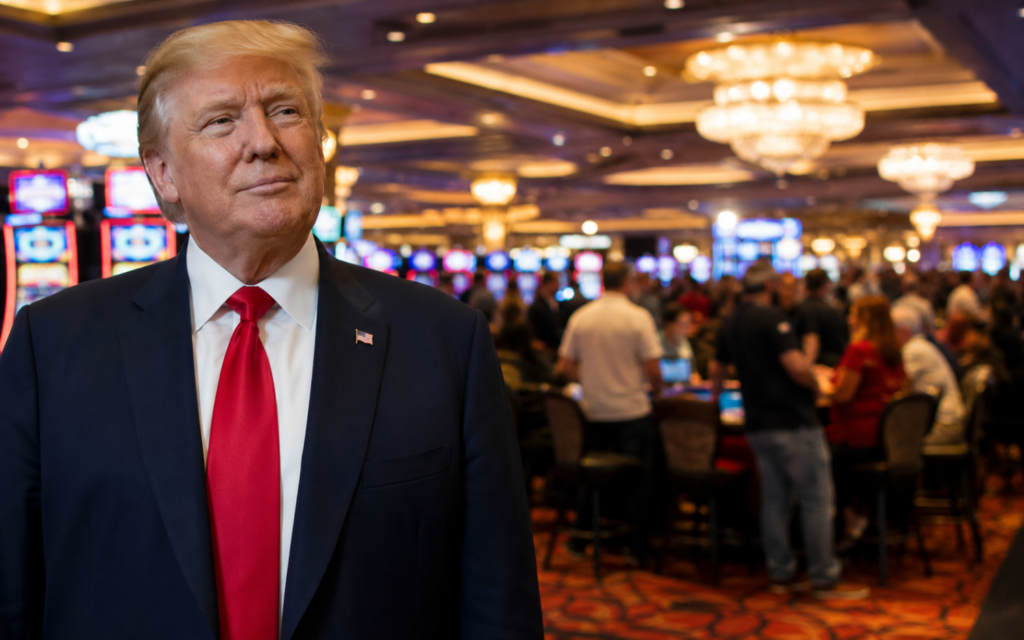
US President Donald Trump returned to Las Vegas this week, using an appearance at Red Rock Casino Resort to promote his tax policies while addressing an audience that included some of Nevada’s most influential gaming executives and political figures.
The 5 August event formed part of a wider push by the White House ahead of November’s midterm elections. Trump highlighted tax provisions covering tipped income, overtime pay and Social Security income, while also endorsing Nevada Governor Joe Lombardo in his reelection campaign.
Las Vegas provided a particularly relevant setting for Trump’s message. The city’s casino, hospitality and tourism workforce contains large numbers of employees who rely on tips, making the federal deduction for qualified tipped income one of the administration’s most visible policies in Nevada.
Under current IRS rules, eligible workers can deduct up to $25,000 of qualified tips from taxable income each year. The provision applies from tax years 2025 through 2028 and begins phasing out for individuals with modified adjusted gross income above $150,000, or $300,000 for joint filers.
Trump first promoted the idea of removing federal tax from tipped income during his 2024 campaign in Las Vegas. During Wednesday’s appearance, he again credited workers in the city’s service sector with inspiring the policy. Reuters reported that the president focused heavily on the tax package during his speech, while also moving into broader political issues ahead of the midterms.
Tourism weakness complicates Las Vegas economic picture
The tax relief arrives at a difficult time for Las Vegas tourism.
According to figures cited by iGamingBusiness from the Las Vegas Convention and Visitors Authority, visitor numbers declined 7.5% in 2025, while passenger traffic at Harry Reid International Airport dropped 6%. Tourism results have remained uneven during 2026, with visitor volumes declining in three of the first six reported months and airport traffic falling further.
Canadian travel has been one area of particular concern. Canada has historically been an important international source market for Las Vegas, but year-to-date traffic involving major carriers Air Canada and WestJet has weakened significantly. Las Vegas tourism officials and casino operators have responded with campaigns aimed at attracting Canadian visitors back to the destination.
The weakness creates an awkward contrast with Trump’s economic message. Nevada has recorded job growth, and the administration has promoted increased tax refunds and deductions for working households, but Las Vegas remains heavily exposed to discretionary consumer spending and international travel.
Tariffs remain a concern for gaming suppliers
Trump also defended his tariff strategy during the Red Rock appearance, another issue with direct implications for the gambling industry.
Casino equipment manufacturers rely on international supply chains for electronic components, displays, cabinets and other hardware. Changing US tariff levels have therefore created additional cost and planning uncertainty for suppliers serving casino operators.
The original iGamingBusiness report noted that gaming equipment manufacturers have been adapting purchasing and production strategies as tariff rules repeatedly change. It cited the Association of Gaming Equipment Manufacturers as saying companies have had to become more flexible in response to disruption and uncertainty.
Trump used the event to argue that tariffs were strengthening the US economy, although the administration’s trade policies remain subject to legal and political challenges.
Fertittas, Ruffin and Dana White attend Red Rock event
The audience also reflected Trump’s longstanding connections with the Las Vegas business community.
Frank and Lorenzo Fertitta, chairman and vice chairman of Red Rock Resorts, attended the event, along with businessman Phil Ruffin and UFC chief Dana White. Red Rock Casino Resort is part of the Fertitta-linked Station Casinos portfolio and operates primarily within the Las Vegas locals market.
Ruffin has particularly close business ties to Trump. His Las Vegas holdings include Treasure Island and Circus Circus, while he also owns half of Trump International Hotel Las Vegas.
White introduced Trump at the event. His presence also highlighted another tax issue affecting gambling that was not addressed during the president’s speech: the treatment of gambling-loss deductions. White has previously pushed the administration to reverse changes limiting how much gamblers can deduct from their winnings for tax purposes.
Nevada politics and prediction markets enter the picture
Trump also backed Republican Governor Joe Lombardo, who is seeking another term in November.
Nevada Attorney General Aaron Ford is challenging Lombardo for the governorship, placing gaming policy close to the centre of an important state race. The contest carries particular significance for the emerging prediction-market sector because Ford’s office has been heavily involved in Nevada’s legal campaign against event-contract platforms.
Nevada regulators have taken one of the toughest positions in the US against prediction markets offering sports-related contracts. The state maintains that such products fall within Nevada gambling laws and cannot be offered without appropriate gaming licences. That position has led to action involving platforms including Kalshi, Polymarket, Robinhood, Coinbase and Crypto.com.
Trump’s Las Vegas appearance therefore brought together several issues currently shaping Nevada’s gambling economy: tax relief for casino workers, declining tourism, tariff pressure on gaming suppliers, prediction-market regulation and an increasingly competitive election campaign.
For the casino industry, the administration’s tax policies may provide tangible benefits to many tipped employees. However, the broader outlook for Las Vegas will also depend on whether tourism demand stabilises and whether uncertainty surrounding trade policy and gambling taxation begins to ease.